
Conceptions of educational equity
Harry Brighouse, University of Wisconsin-Madison
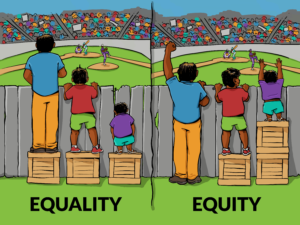
Nearly everybody says they are in favour of equity in education. But what are they in favour of when they are in favour of equity? A famous meme using crates, people of different sizes, and a baseball game, contrasts equity, in which everyone gets as many boxes as they need to see the game, with equality, in which everyone gets the same number of boxes regardless of size. But in the cartoon, equity is really equality of outcome, whereas equality is equality of crates. We explore various plausible ways of understanding equity, and demonstrate that different organisations have different and incompatible understandings of equity, and show why understanding the different ways we conceive of equity matters for decision-making.
Harry Brighouse is Mildred Fish Harnack Professor of Philosophy, Carol Dickson Bascom Professor of Humanities and Affiliate Professor of Educational Policy Studies at the University of Wisconsin–Madison. He has research interests in political philosophy, ethics, applied ethics and philosophy of education. His books include School Choice and Social Justice (OUP, 2000), On Education (Routledge, 2005), Family Values: The Ethics of Parent-Child Relationships (Princeton University Press, 2014) (with Adam Swift), and Educational Goods: Values and Evidence in Decisionmaking (University of Chicago Press, 2018) (with Adam Swift, Helen Ladd and Susanna Loeb). He directs the Center for Ethics and Education and is a regular contributor to the academic blog Crooked Timber.