The Conservative Government defends its Police, Crime, Sentencing and Courts Bill as a “sensible package of measures,” justly tough on the worst violent offenders – especially those who commit violent and-or sexual crimes against women. Critics say it’s an authoritarian bill which will erode our rights of assembly and protest. They note that – despite Government claiming it will better protect women and girls – the word “woman” doesn’t appear once in the Bill’s nearly 300 pages.1 Human rights organization Liberty says the Bill will “expose already marginalised communities to profiling and disproportionate police powers,” and is particularly worried about the Bill’s impact on Gypsy, Roma, and Traveller communities.
The Bill passed its second reading on March 16, 2021, the same day that six Asian women were shot and killed in Atlanta, Georgia. While some news agencies are foregrounding the question of whether or not the Atlanta murders are a hate-crime, authorities (at the time of writing) say it’s too early to use that label. Online criticism of this reticence has been sharp:2

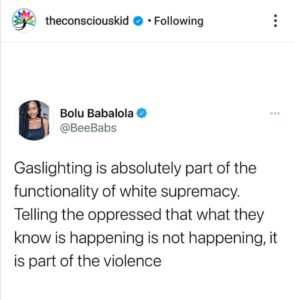

To frame the Atlanta murders as a race-, sex-, and gender-based hate crime is to frame them in a way broadly consistent with critical race theory (CRT), and to do so in intersectional terms.3 The language and perspectives of CRT and intersectionality are not, in themselves, solutions to the problems of intersectional inequalities and violence. But if these political problems are to be addressed, we need a shared diagnostic language; we need lenses that might bring these problems into sharp focus.
CRT is certainly ideological, inasmuch as it’s anti-racist, anti-sexist, anti-chauvinist. But though CRT is ideological – as any moral-political stance must be – it isn’t an ideology, despite Women and Equalities Minister Kemi Badenoch’s claim, made in a Commons debate in October 2020, that it is “a dangerous and divisive ideology that should not be adopted in educational theory.” She went on to say, with respect to CRT, that she and Government
do not want teachers to teach their white pupils about white privilege and inherited racial guilt. Let me be clear that any school that teaches those elements of critical race theory as fact, or that promotes partisan political views such as defunding the police without offering a balanced treatment of opposing views, is breaking the law.
Badenoch’s timing is interesting. In September 2020, the Government announced that materials published by “extremist” groups – including anti-capitalist organizations – must not be used in schools.4 The same month, following the international Black Lives Matter protests prompted by George Floyd’s murder and the toppling of the Colston statue in Bristol, museums in England received a letter from the Government, which threatened to withdraw funding should the museums remove controversial statues. In the October Commons debate already cited, Badenoch characterized Black Lives Matter as “anti-capitalist.” Interesting that “anti-capitalist” is being used as if its moral indefensibility were self-evident.
Presumably, the strategy here is to contrast the insidiousness of CRT, the fake-newsiness of white privilege, and other associated critical discourses with the Government’s pragmatic, non- or post- or extra-ideological stance: Black Lives Matter is political, the Government, though, is not; criticism of “our” (though one wants to ask “whose?”) history and culture is (possibly) illegal (and, if you’re Priti Patel, thuggish), celebration of it… what – good common sense and simple rightmindedness?
The presumption seems to be that some ways of speaking about the world are ideologically framed (and that is bad), while others are frameless – and therefore true, therefore good. Truth just is. All else is mere perspective at best, dangerous ideology at worst.
The Government’s solution to problems of systemic intersectional violence and inequalities is an educational one: problems will disappear if we no longer have the language with which to speak about, explore, and diagnose them; if we are all made to wear frameless glasses, the lenses of which filter out “undesirable” shades and hues; and, crucially, if we are too scared to hold certain conversations and teach certain histories (and the processes by which those histories are constructed). Smart move, then, to try to police what conversations can and can’t take place in educational institutions.
The Government is attempting to intervene in and to stipulate what does and doesn’t count as knowledge (even as it rejects the idea that knowledge is socially constructed). It’s doing this in a way that could – if we’re not careful – make it harder (because personally and professionally risky) to say that this is what it’s doing. Attempting to ban CRT in schools, while proposing a “free speech champion” be appointed to combat “woke” campus culture and offer a means of redress for those who’ve been “no-platformed”: such moves will sound to some of us like attempts to protect overt and covert chauvinisms and to quash critical discourses.
We should be worried about the Government’s authoritarianism: freedom of speech and of movement – including freedoms of association and to protest – are inextricably linked. The Government is attempting to restrict the latter with its policing Bill, the former with its lies about CRT’s supposedly insidious effects on education. By constricting freedoms of movement, association, and speech, the possibilities for either moral debate or political solidarity on any wing other than the right may be drastically reduced.
Notes
1 See here for Hansard’s transcript of the debate.
2 Images reposted by The Conscious Kid on their Instagram account.
3 If you’re unfamiliar with Critical Race Theory and-or intersectionality, start with Kimberlé Crenshaw’s podcast, Intersectionality Matters. Episode 31 is useful for its comments on what CRT is and isn’t. The episode focuses on Trump’s gag order on CRT (rescinded by President Biden) – an unsettling parallel between the American and British scenes.
4 As John McDonnell pointed out, this edict, if taken at face value, will make it impossible to teach certain events in British history.
This post is available here as a PDF (here).