(Above is an audio recording of the blog post)
But sometimes, on the contrary, it is necessary to make holes, to introduce voids and white spaces, to rarify the image, by suppressing many things that have been added to make us believe that we were seeing everything. It is necessary to make a division or make emptiness in order to find the whole again. (Deleuze, 1989, p.21)
Contemporary educational AI promises seamless integration and comfort by optimising learning environments and eliminating classroom complexities, such as errors, inefficiencies, or stress (Ball, 2003; Selwyn, 2024). Framed as a helpful partner, AI purportedly unlocks student potential through effective process support (Marrone et al., 2022). Conversely, critics highlight risks to intellectual integrity, information accuracy, and critical oversight (Zhu et al., 2025). Specifically, AI hallucination—the generation of plausible yet deceptive outputs—has emerged as a primary technical and ethical concern (Shao, 2025).
This blog, however, argues that concerns about AI hallucination in educational AI may, paradoxically, be caused by us rather than the technology itself. Ironically, this issue is not only about the technical limitations of AI, but also about our ego: we unconsciously exclude ambiguity, waste, deviation, abnormality, and discomfort in the pursuit of efficiency, effectiveness, and performativity (Ball, 2003; Biesta, 2010). I am not here to discuss the AI threat, school-wide bans, regulation, or human-centred use (Stellinga et al., 2025); it is time we think about education itself.
When we consider AI today, few still imagine the violent, cinematic dystopia of The Terminator series. Instead, one thinks of more realistic concerns, such as AI hallucination (Sun et al., 2024; Shao, 2025). This phenomenon is more complex than just misinformation or a simple technical malfunction (Shao, 2025). AI hallucinations are the misleading outputs created by AI platforms like ChatGPT, Gemini, and Claude that look credible but carry factual errors or made-up information (Augenstein et al., 2024; Sun et al., 2024). Unlike human-generated misinformation, which is driven by bias, motivated reasoning, or intent to mislead, AI hallucination occurs because the model produces outputs by statistically predicting the next word from patterns in its training data (Shao, 2025). The output is instantly absorbed, perceived as a seamless, seemingly coherent reality that leaves no room for doubt (Augenstein et al., 2024; Shao, 2025). The problem is not that it looks like a problem; the problem is that it doesn’t. Or, more precisely, that we are trying not to see it as a problem. This leads to a disturbing realisation: AI hallucination is not merely a glitch in the machine, but a phenomenon co-constructed through its intimate relationship with us.
AI hallucinations function much like a technologically intensified form of Deleuze’s ‘clichés’ (1989, p. 21), the familiar, plausible, preexisting images we habitually recognise. Clichés are preconceived images that shape our perceptions and thought patterns in advance. When we perceive something, rather than perceiving it anew, we perceive it through the existing thought patterns and sensations we already possess (Deleuze, 1989). In other words, we perceive something in the way we want to perceive it.
More importantly, clichés are not just external, pre-existing knowledge. Rather, they operate like Lacanian fantasies (Stock and Peim, 2025). Based on a Lacanian perspective, Stock and Peim (2025) argue that fantasy in education functions as a protective mechanism that shields us from the ‘Real’ (p. 71). In educational settings, the Real refers to the traumatic elements inherent in the classroom, such as teachers’ slips, students’ errors, deviations, misunderstandings, and general discomfort. To turn our eyes away from this chaotic educational Real, we find ourselves necessitating the smooth, plausible answers, i.e., the fantasies, offered by AI. If we continue to pursue this comfort, treating noise and deviation in education as mere defects, and employ AI to mask these elements, we are captured in the prison of the cliché—within the exact hopeless fantasy that Deleuze and Guattari (1996) criticised.
Deleuze (1998, 2003) argues that these clichés bring our thinking to a halt. We mindlessly repeat the same perceptions and behaviours out of habit, to the point at which we no longer maintain a critical gaze towards what we see. While this presents us with a sense of perfection, it prevents us from straying from that predetermined path and creating new concepts or worlds. Furthermore, enclosure within the plausible inhibits what Deleuze (1983) refers to as ‘productivity of libido’. In this interpretation, libido is not a drive to fill a lack or satisfy a need; rather, it is a productive force, an energetic drive of thought that constantly seeks to generate and create new concepts and realities beyond the existing world. When AI provides a sense of omnipotence by catering to the learner’s every comfort, the potential for genuine creation is imprisoned within plausible answers, a fantasy.
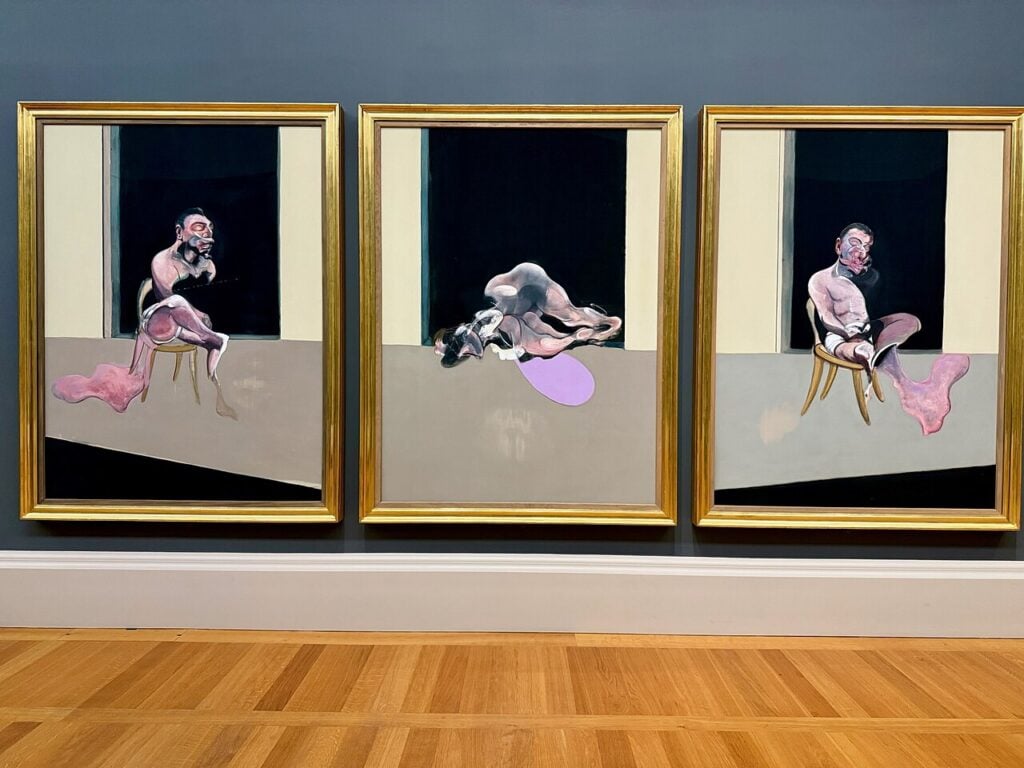
Deleuze (2003) shows that resistance to the familiar can open a pathway to new worlds and a renewal of life. Encountering unexpected, thought-provoking, even uncomfortable experiences (such as Bacon’s grotesque paintings) releases viewers from the cliché, awakening a sense of creation. In this moment, we are disconnected from the world we had taken for granted, and the genesis of new life is possible. In education, disrupting the cliché creates the room for learning (Deleuze, 1986; Deleuze, 1989; Biesta, 2010). Such cognitive dissonance and ‘head-scratcher’ moments spark thought, opening the possibility for curiosity in the learner.
From this perspective, we should not view the AI hallucination as merely a technological malfunction; our desires are part of the phenomenon. While education has long pursued efficient, comfortable, and rational pathways for learning (Ball, 2003; Biesta, 2010), this pursuit also prevents us from confronting deviations, detours, wildly imaginative ideas, or unexpected outcomes—the encounters that challenge us.
Returning to the opening metaphor, we should strive to create gaps and introduce voids in educational practices. Restoring incompleteness and indeterminacy to educational spaces will move us beyond technical fixes. Ultimately, this is not about how we should improve AI; it is an ontological question about how education should be and how we want to change it.
References
Augenstein, I., Baldwin, T., Cha, M., et al. (2024). Factuality challenges in the era of large language models and opportunities for fact-checking. Nature Machine Intelligence, 6, 852–863. https://doi.org/10.1038/s42256-024-00881-z
Ball, S. J. (2003). The teacher’s soul and the terrors of performativity, Journal of Education Policy, 18(2), pp. 215–228. doi: 10.1080/0268093022000043065.
Biesta, G. J. J. (2010). Good education in an age of measurement: Ethics, politics, democracy (1st ed.). Routledge. https://doi.org/10.4324/9781315634319
Deleuze, G. (1986). Cinema 1: The movement-image (H. Tomlinson & B. Habberjam, Trans.). University of Minnesota Press.
Deleuze, G. (1989). Cinema 2: The time-image (H. Tomlinson & R. Galeta, Trans.). University of Minnesota Press.
Deleuze, G., & Guattari, F. (1996). Anti-Oedipus: Capitalism and schizophrenia (R. Hurley, M. Seem, & H. R. Lane, Trans.). University of Minnesota Press. (Original work published 1972)
Deleuze, G. (2003). Francis Bacon: The logic of sensation (D. W. Smith, Trans.). Continuum.
Marrone, R., Taddeo, V., & Hill, G. (2022). Creativity and artificial intelligence – A student perspective. Journal of Intelligence, 10(3), 65. https://doi.org/10.3390/jintelligence10030065
Selwyn, N. (2024). On the limits of artificial intelligence (AI) in education. Nordisk tidsskrift for pedagogikk og kritikk, 10, 3–14.
Shao, A. (2025). New sources of inaccuracy? A conceptual framework for studying AI hallucinations. Harvard Kennedy School Misinformation Review, 6(4). https://doi.org/10.37016/mr-2020-182
Stellinga, L., Korenhof, P., & Blok, V. (2025). Making sense of the “Human” in human-centered AI: an Arendtian perspective. AI & Society. https://doi.org/10.1007/s00146-025-02769-x
Stock, N., & Peim, N. (2025). The lacanian teacher : Education, pedagogy and enjoyment. Palgrave Macmillan.
Sun, Y., Sheng, D., Zhou, Z., & others. (2024). AI hallucination: Towards a comprehensive classification of distorted information in artificial intelligence-generated content. Humanities and Social Sciences Communications, 11(1), 1278. https://doi.org/10.1057/s41599-024-03811-x
Zhu, H., Sun, Y., & Yang, J. (2025). Towards responsible artificial intelligence in education: A systematic review on identifying and mitigating ethical risks. Humanities and Social Sciences Communications, 12, 1111. https://doi.org/10.1057/s41599-025-05252-6