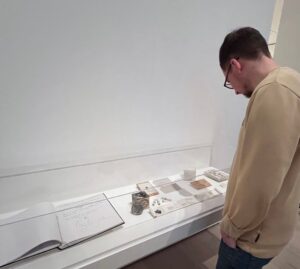
Nathaniel Woodward at MoMA.
Nathaniel Woodward reflects on his experience visiting The Gilbert and Lila Silverman Fluxus Collection Archives in New York
Researching about something as enigmatic as the art-network Fluxus has been frustrating, but largely rewarding; I have been just as puzzled by it as others have when I mention that it is my research topic. Its enigma is found in its refusal to any form of art, or philosophical categorisation, making it readily challenging to theorize. With notable contributors such as Nam June Paik and Yoko Ono; New York’s Museum of Modern Art describes Fluxus as ‘founded by George Maciunas and chiefly active from the early 1960s to the late 1970s’, it ‘was a loose international group of artists, poets, and musicians with a shared impulse to integrate art and life’ (MoMA 2024). In his Manifesto, Maciunas called it Fluxus because it derived from the term ‘flux’, which was to represent a changing energy of ‘flow’ and ‘flood’ in the art world. My research explores the implications of Fluxus in aesthetic educational thought, specifically regarding the pedagogical imperative of process that underpins a lot of the works. This is because, for Fluxus artists, much of the aesthetic value is contained within the process of creating, rather than finished objects that typically characterise the aesthetic presentation of artwork. Therefore, any ‘finished’ objects that are a consequence of this notion seemingly hold no real value. As Pincus-Witten states, ‘a Fluxus work must be cheap and mass-producible’ (Pincus-Witten 1988, 25). As such, it was intended to not only to erode some of the normative assumptions of value in high-art culture, but also allow art to reach mass audiences.
Ironically, despite its efforts to do this, a lot of Fluxus works still find themselves locked away behind glass cabinets, appearing either in ephemeral exhibitions, or in collections that do not capture the dynamism of the work; as the image above illustrates. If not here, then like many collected artworks, the Fluxus oeuvre spends much of its time behind the closed doors of an archival fortress. This is why I’m very grateful to not only the archivists at MoMA, but also to PESGB’s small grant scheme, for giving me the opportunity to visit The Gilbert and Lila Silverman Fluxus Collection Archives in New York. Researching a topic where the primary experience of the work is now predominantly found in archival material and written reflections makes it difficult to attend to the exuberant spirit that was once so integral to the creative process of the work. Consequently, although seeing some of the selected works first-hand was profoundly informative to the progression of my doctoral thesis, it left me feeling rather perplexed.
One of the main reasons for this was witnessing the degree to which Fluxus work had become what it set out to ‘purge’; that is, ‘an unwilling stakeholder in an art market that Fluxus never intended to enter’ (Friedman & Smith 2006, 7). Considering that Fluxus works encourage, or more accurately, require movement and tactile encounters, it is disconcerting that they now find themselves bought and sold on the private art market, or locked away in secure storage environments. I do not think that anything could be more painful to someone like artist Ay-O, for example, that his Put Finger in Hole from Fluxkit (1965) is now off limits to putting your finger in the hole. How confusing to be told by the art itself to do something, but also to be told, or physically blocked, from doing so. This made me think further: how can the legacy of an artwork be fully ascertained when it cannot be fully realised? The answer lies in compromising with the extent to which we can still learn about mobile artforms in immobile environments such as archives and museums that typically promote static, historiological modes of thinking.
Considering that one of the main aspects of all Fluxus work is disclosed by its performative nature – as Higgins puts it, ‘the audience has to do something to complete the work’ (Higgins 2002, 25) – it is challenging to imagine how this process can occur when it lies inanimate behind closed doors. It is said that one of the best qualities of Fluxus is that ‘it is perceived as open, inviting and fun. It gives permission and it is permissive’ (Friedman & Smith 2006, 7). Given that this is key to the Fluxus legacy, I wonder whether someone now encountering Fluxus may miss the opportunity to fully grasp its spirit, and therefore be left imagining what it might be like to touch what is inside the finger hole. Maybe we can only scratch the surface of some Fluxus ideas without fully experiencing them? That being said, Fluxus ideas are purposively more than just the art objects. So, luckily, there is more in playing around with them, rather than despairing over the ‘do not touch’ sign.
References
Friedman, K. & Smith, O. (2006) ‘The Dialectics of Legacy,’ Fluxus After Fluxus. Rhode Island: Rhode Island School of Design, Visible Language.
Higgins, H. (2002) The Fluxus Experience. California: University of California Press.
Maciunas, G. (1963) Manifesto 1, George Maciunas Foundation: https://georgemaciunas.com/about/cv/manifesto-i/.
MoMA (2024) ‘Art Terms: Fluxus’, https://www.moma.org/collection/terms/fluxus.
Pincus-Witten, R. (1988) ‘Introduction,’ in Hendricks, J. (ed) Fluxus Codex. New York: Gilbert and Lila Silverman Fluxus Collection in association with H.N. Abrams.