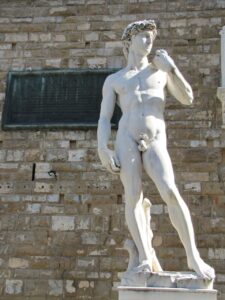
At the height of the Renaissance, Michelangelo unveiled David. This was also the unveiling of the ‘Renaissance man’. In examining this towering figure, one notices that his head and hands are slightly larger in proportion to the rest of his body. These details express that the perfect human possesses both craft in hands and theory in head. They represent the Renaissance creed arte e scienza. Art and science united in one body makes a polymath. Polymaths were the driving force behind the Renaissance’s explosion of learning.
Today, few dare work their hands and head in unity. Specialisation has torn arte e scienza apart. Professionalisation has created their hierarchy where ‘science is now in a position to become the leader of the humanities’ (Waddington 1948, 61). ‘Science’ has become ‘a title of honour’ (Midgley 1989, 94) bestowed upon disciplines deemed worthy of it. It has given learning a telos in science. Yet its archè has always been art, in sensing creatively before understanding intellectually. For Rousseau, this is true individually as ‘man’s first reason is a reason of the senses; this sensual reason serves as the basis of intellectual reason’ (Rousseau 1991, 125). For Vico, this is also true for humanity since ‘the poets were the sense of mankind, and the philosophers its intellect’ (Vico 2001, 136). Individual and collective learning begins with arte and ends in scienza.
What David represents is their equilibrium – humankind’s polymathic origins. As written in the Oration on the Dignity of Man, ‘the Master Creator decreed that the creature to whom He had been unable to give anything wholly his own should share in common whatever belonged to every other being’ (della Mirandola 2012, 17). The result of being given nothing specific is that ‘you may, as the free and extraordinary shaper of yourself, fashion yourself in whatever form you prefer’ (della Mirandola 2012, 22). This has been the success formula for humankind’s diverse learning. Yet it is a winning formula that has changed, and the polymath who follows it is a dying breed.
What sets the polymath apart is that they not only follow the journey of arte e scienza, one the arché and the other the telos, but maintains throughout their equilibrium. It is the polymath with hands and head united, with creativity and understanding cooperating, that sees the fruitful synergy between education in all disciplines. Arte e scienza fuel each other. As spoken by Umberto Eco, ‘Whereof one cannot theorize, thereof one must narrate’ (Paolucci 2017, 165). I dare add that ‘whereof one has narrated, one must subsequently theorize’. The result is a circle of learning where one both creates and understands the world, arte picking up where scienza falls short and vice versa. Arte e scienza is the polymath’s state of mind throughout. It is a journey of amassing more and more disciplines between these two poles, yet never fulfilled in either of them.
The two poles are different as ‘Nature by the medium of genius does not prescribe rules to Science but to Art’ (Kant 1914, 190). To Kant, ‘Genius is the talent (or natural gift) which gives the rule to Art’ (Kant 1914, 188). Genius is creative as its work gives new rules to its field. Science, on the other hand, rests on discovery. It can be learned, ‘but we can never learn to write spirited poetry’ (Kant 1914, 190). An artistic origin is therefore the polymath’s advantage, for that cannot be learned. Art is the beginning and sustaining spark throughout lifelong polymathic education.
It must be kept alive because this spark brings creativity out of mere discovery. Understanding the world through different disciplines inevitably leads to contradictions, so limiting oneself to one makes sense. Nevertheless, such limitation is not fertile ground for creativity. It is ‘this balance of apparent contradictions that has been the whole buoyancy of the healthy man’ (Chesterton 1909, 47). Amassing contradictions of disciplines is key in thinking creatively. It creates the necessary realm of impossibilities, and ‘without a set of impossibilities, you won’t have the line of flight, the exit that is creation’ (Deleuze 1995, 133). The creativity of arte is the output of polymathy, the understanding of scienza is the fuel.
Education is what connects the many interests of any aspiring ‘Renaissance man’. Education is what connects David’s hands and head, running through his body like a blood stream granting him exemplary polymathic life. Sculpting oneself in David’s image leads to a life of polymathic learning where scienza is inhaled and arte exhaled. The polymath is nature’s most productive machine, for he is the most human. I urge the resurrection of this ideal. I urge us to combat specialisation with more learning. I urge us to once more believe, that when it comes to education, we can have it all.
References
Chesterton, G. K. (1909) Orthodoxy. New York: John Lane.
Deleuze, G. (1995) Negotiations. New York: Columbia University Press.
della Mirandola, P. (2012) Oration on the Dignity of Man. Cambridge: Cambridge University Press.
Kant, I. (1914) Kant’s Critique of Judgement. London: Macmillan and Co., Limited.
Midgley, M. (1989) Wisdom, Information, and Wonder. London: Routledge.
Paolucci, C. (2017) ‘Whereof One Cannot Theorize, Thereof One Must Narrate,’ in Thellefsen, O. and Sørensen, B. (eds) Umberto Eco in His Own Words. Berlin, Boston: De Gruyter Mouton. 165-173.
Rousseau, J. (1991) Emile, or On Education. London: Penguin.
Vico, G. (2001) New Science. London: Penguin Books.
Waddington, C. H. (1948) The Scientific Attitude. Middlesex: Penguin Books.