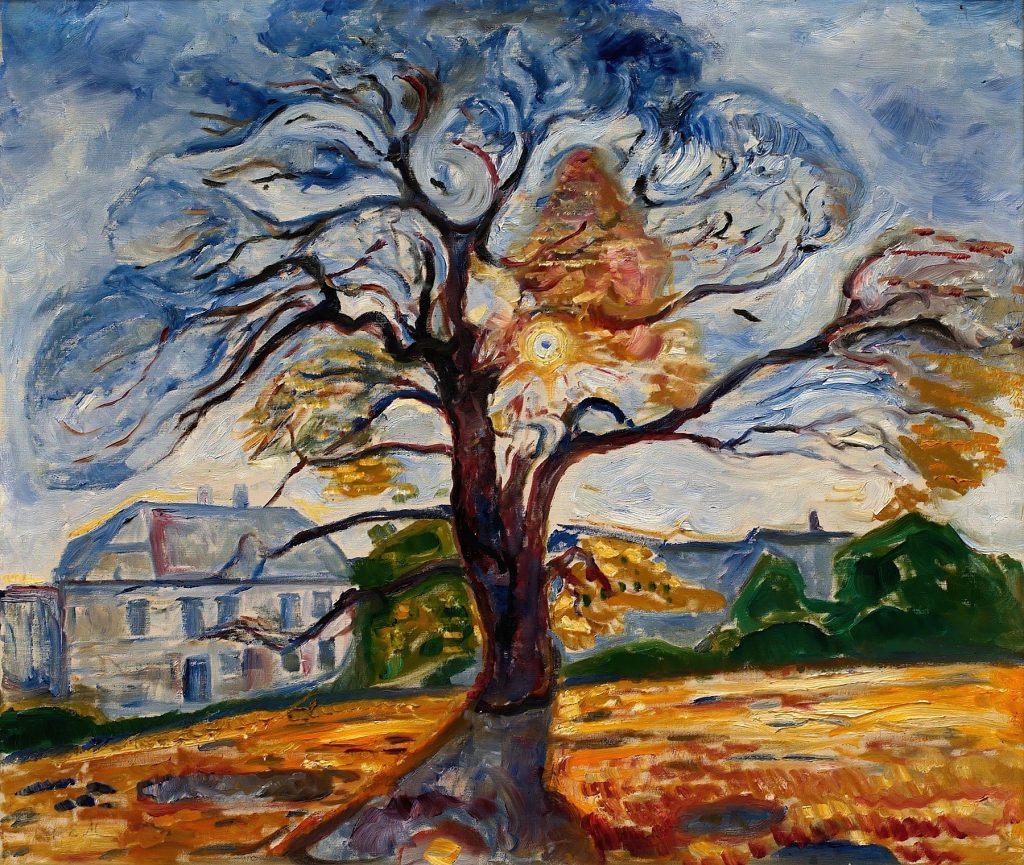
Edvard Munch, “The Oak” (1906)
A recent report identified a growth in the use of standardised curricula in both primary and secondary schools in England. These resourced schemes of work are considered ready for teacher use and often take the form of PowerPoint presentations. They exist within individual schools, across schools linked through Multi Academy Trusts, and at a national level in the form of commercial packages and the Department for Education sponsored Oak National Academy (Oak) resources.
The report from Traianou et al. (2025) goes on to suggest standardised curricula may be a first step in creating a diminished role for teachers where subject specialists are no longer needed. This draws attention to the fact that standardised curricula in England are being introduced in an educational milieu of capitalist, neoliberal, and neoconservative ideologies that seek to reduce costs in a drive for efficiency. For simplicity I will refer to the free-market system since I see this as an underpinning feature of the milieu. In this article I seek to apply the arguments of McGowan (2016, 2019) to help consider the growth in use of standardised curricula in England.
Firstly, the particular view of human behaviour I adopt is grounded in the McGowan’s philosophical perspective. Though there is not space here to expand on his full argument, McGowan reasons that Hegelian contradiction (the failure to be identical) is an ontological feature. One important consequence of this is that he therefore identifies human behaviour as also being defined by contradiction through the conscious and the unconscious. Drawing on Freud’s work in Beyond the Pleasure Principle, McGowan argues some human behaviour can be understood as a subject finding satisfaction in the repetition of failure. As a corollary he argues a subject will unconsciously subvert their conscious desires to sustain the conditions for failure.
Secondly, relating to the current educational milieu, McGowan argues one reason for the hold of the free-market system is that it feeds the contradiction-based understanding of human behaviour. By creating a lost object through signification, the free-market system encourages the subject to believe satisfaction can be found in accumulation. The free-market system then offers commodities that fall short of the lost object, but from which the human psyche derives satisfaction in the failure. From this perspective it should be acknowledged a free-market system does lead to satisfaction, but the source of that satisfaction has been obfuscated. It is in recognising the true source of satisfaction that an internal alternative to the free-market system may be glimpsed.
To illustrate, standardised curricula become a lost object of “standardised curricula” through a process of signification. For example, the Oak resources are not just presentation materials but are “standardised curricula” claimed to help teachers save time, become confident, and become effective . The fantasy of “standardised curricula” becomes divided from the reality of standardised curricula. Consequently, the standardised curricula lead to inevitable disappointment as they fall short of the fantasy. Indeed, in their report Traianou et al. (2025) note teachers who used standardised curricula did not save time but merely changed the nature of their lesson preparation. Our unconscious finds satisfaction in the failure of the standardised curricula since it maintains the fantasy of “standardised curricula”. We then look forward to the next iteration of the standardised curricula and the upgrades they promise. The free-market system provides repeated promises of satisfaction through standardised curricula, but the satisfaction is actually located in their failure to be “standardised curricula”.
The (psychoanalytic) cure to the problem comes from recognising the free-market system does create satisfaction, but this satisfaction is the result of its failure not its promise. It is not accumulating the new standardised curricula that brings satisfaction but sustaining the conditions that allow us to believe that one day they will provide an increase in time, confidence, and effectiveness. The cure is found in recognising no standardised curricula will ever offer us the lost object of “standardised curricula”. In doing this we can be freed from the shackles of accumulation offered by the free-market system.
In conclusion, the interpretation of human behaviour I have adopted, alongside the current educational milieu, suggests to me there will be an inevitable growth in the use of standardised curricula in England. Moreover, if standardised curricula are continually offered as “standardised curricula” I concur they offer a threat to the professionalism of teachers. However, the opportunity to strip the free-market system of its power lays in recognising the source of satisfaction resides in failure. To this end I suggest all standardised curricula must be accompanied by professional learning communities which study their shortcomings. In doing this the power of the free-market is removed, the fantasy of a solution is denied, and teachers are freed to study learning experiences in their classrooms.
References
McGowan, T. (2019). Emancipation after Hegel: achieving a contradictory revolution. New York, NY: Columbia University Press.
McGowan, T. (2016). Capitalism and desire: the psychic cost of free markets. Chichester: Columbia University Press.
Traianou, A., Stevenson, H., Pearce, S. and Brady, J. (2025, March 25). “Are you on slide 8 yet?”: The impact of standardised curricula on teacher professionalism. National Education Union. https://research.gold.ac.uk/id/eprint/38749/