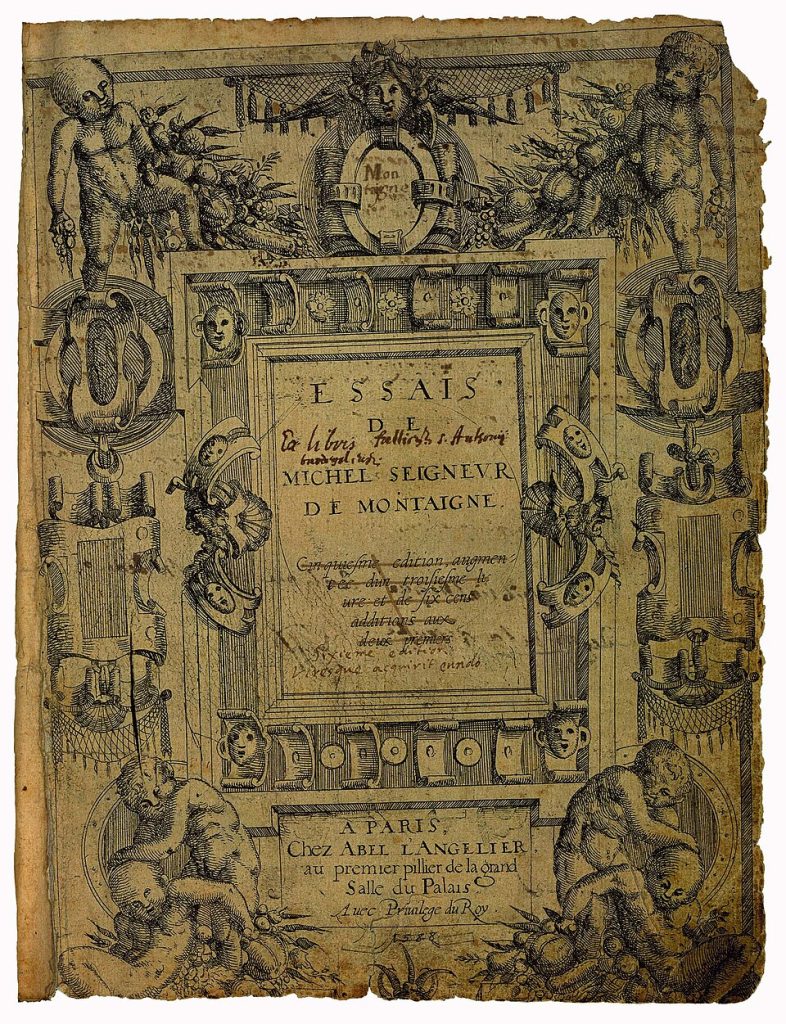
(Essais, de Montaigne, 1595)
The essay is a unique way of approaching education. It can be part science in that it means ‘to test’ or ‘to experiment’. Conversely, it can be part art in that in that it is an introspective wandering through the subject matter. As a whole, it transcends disciplinary boundaries. In the essay you are not just a physicist writing about physics, nor an art historian writing about art history. No, you are you, the learner, writing about these subjects through your own experience. As such, I argue that the essay is an ideal form of assessment in education. It is a way of approaching knowledge where frontiers between disciplines dissolve simply by wandering across them. It places the learner at the centre and prepares them for lifelong education in an increasingly interdisciplinary world.
The essay’s opposite is the exam. In the exam, a single subject is rigorously tested against a rigid discipline-specific criterion. This, of course, has its uses. A doctor needs to know their pathology. An engineer needs to know their material science. However, what the exam assesses is precisely the doctor and the engineer, not the learner behind those roles. It fixes knowledge to one role, to one situation, and does not necessarily fuse it with the learner’s own experience. Dewey puts experience at heart of education. He highlights the problem of learning ‘in a water-tight compartment’. What has been learned can then only be recalled within the exact same conditions because ‘it was segregated when it was acquired and hence is so disconnected from the rest of experience that it is not available under the actual conditions of life’ (Dewey, 1997, p. 19). The knowledge is tied up in a specific role. It has not dissolved into true-to-life experience.
‘All the world’s a stage, […] and one man in his time plays many parts’ (Shakespeare). Lifelong education is about the person playing the parts, and preparing them for as many as possible. Bringing it back to Dewey, ‘What he has learned in the way of knowledge and skill in one situation becomes an instrument of understanding and dealing effectively with the situations which follow. The process goes on as life and learning continue’ (Dewey, 1997, p. 18). Our world requires lifelong learning. We must therefore prioritise the constant. In a world of shifting professions, the person must be at the centre. Here enters the essay.
The essay is free from rigorous methodology by virtue of meaning precisely ‘to try’. It does not fix knowledge to any one situation but rather internalises it by wandering through it. The wanderer is you the learner, unfettered by any one discipline. Consequently, it is an inherently interdisciplinary space. In Of the Education of Children, the father of the essay lays out his way of approaching knowledge. ‘Bees cull their several sweets from this flower and that blossom, here and there where they find them, but themselves afterwards make the honey, which is all and purely their own, and no more thyme and marjoram’ (de Montaigne, 2003, p. 195). By way of analogy to the learner, de Montaigne (2003) writes: ‘Similarly the boy will transform his borrowings; he will confound their forms so that the end-product is entirely his’ (p. 195). The knowledge learned thus ceases to be subject-specific. Through the essay it becomes life-general.
The essay internalises knowledge by wresting it from its original situation and blending it with other learning. This blending creates an intricate net that is the learner’s own weaving and can then be cast forward to catch new knowledge. The act of writing is essential in this interweaving. As Nawal El Saadawi (2010) remarks, ‘Writing slows us down, makes us think, rethink, contemplate, connect different disconnected ideas (p. 8). Writing the essay creates a necessary distance from what is learned. It thereby creates a space for connecting it to yourself by way of interconnection with other knowledge. This is precisely how essay-writing prepares the learner for the interdisciplinary age. ‘Through creative writing we undo the false opposition between emotion and reason, between the irrational and rational, between the scientific and the literary or fictional’ (El Saadawi, 2010, p. 9). The act of writing blends diverging knowledge. The learner wielding the pen reaps the greater whole.
Writing essays is the experience of wandering through a vast forest of diverging knowledge, picking up different flowers and blossoms along the way. The learner weaves all these together into something completely their own. No more single flower or blossom, but an interwoven net that allows the learner to gather even greater knowledge on their lifelong educational journey. Not only is the essay an enjoyable form of assessment that places the learner at the centre. The essay is about experimenting your way through life. And what is life but one long experiment.
References
de Montaigne, M. (2003). The Complete Essays. London: Penguin Books.
Dewey, J. (1997). Experience and Education. Free Press.
El Saadawi, N. (2010). How to Write and Why. In A. Newson-Horst, The Essential Nawal El Saadawi: A Reader (pp. 7-9). London: Zed Books Ltd. http://dx.doi.org/10.5040/9781350223110.
Shakespeare, W. (2025). Speech: “All the world’s a stage”. Poetry Foundation: https://www.poetryfoundation.org/poems/56966/speech-all-the-worlds-a-stage