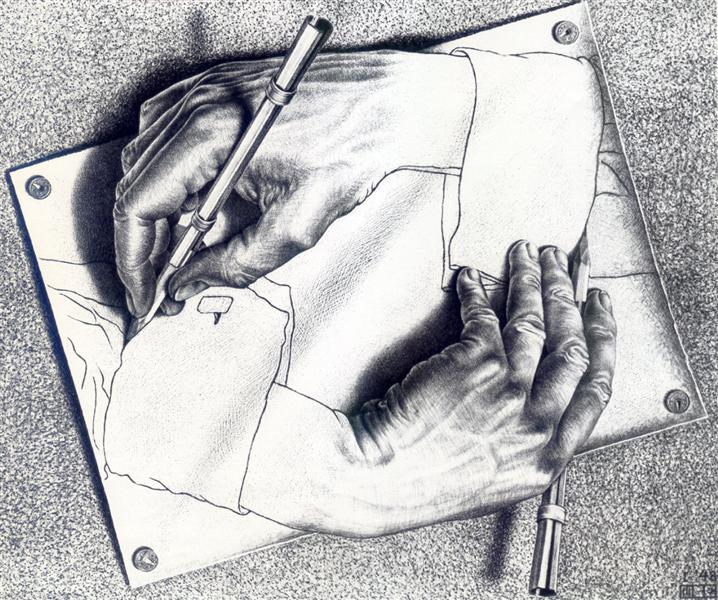
(Drawing hands, M. C. Esher, 1948)
“Man is nothing else but that which he makes of himself. That is the first principle of existentialism.” – Jean-Paul Sartre (1989)
One of the most important things we can do in education is giving students the means to define themselves. We teach them the skills to become doctors, lawyers, engineers, to become something. But before all that should come the tools to make them into someone. The tools to make something of yourself are not textbooks for this or manuals for that. It is words. I therefore write in favour of teaching vocabulary. Because those many words, with many more meanings, are the basis for defining yourself in a time determined to reduce you to a profession.
You do not enter school a doctor-in-becoming, or at least you should not. In school, as in the existential life, ‘existence precedes essence’ (Sartre, 1989). You are first and foremost a child and should seek above all to make yourself into an adult. For it is only the responsible adult that you make of yourself that can decide which profession to pursue without losing yourself. Defining yourself comes before delineating yourself. Or, who you are must come before what you do. And definitions, as all those in school are painfully aware, are a matter of words. But finding the words need not be a painful exercise at all. It is an act of writing yourself into being.
Telling of this is the title of Jean-Paul Sartre’s autobiography – The Words. As the title suggests, his becoming is equated with finding his words. Finding the words in and of your life is the same as writing it. The words and their meanings can be used inwards to create yourself. What better use can vocabulary possibly be put to? Yet vocabulary lessons in school seem to have an outward and upward perspective. Words denote things you can use in order to advance you to the skills to use them. But who is this you that will use them? Have they been properly defined first?
I propose we take learning vocabulary seriously as an educational, and existential, task. Words are not solely words. They are also ideas. Ferdinand de Saussure separates the word as a linguistic sign into concept and sound-image (1959). The word can be separated into how it sounds and is written, and what it means. Rote learning of vocabulary is agonising when you just progress from single word to single meaning in isolation. It misses the point, the joy, of stringing them together and seeing different meanings emerge in different combinations. Learning vocabulary should therefore mirror the structure of Sartre’s autobiography. Part 1 is called Reading, Part 2 Writing (Sartre, 1964).
It is with engaging with both parts of the linguistic sign, all aspects of the word, that learning vocabulary becomes a meaningful task. Because it is by musing over words’ many meanings and uses that they gain the same complexity as ourselves. Only then do they become worthy of defining us. James Joyce’s semiautobiographical novel, A Portrait of the Artist as a Young Man, is centred around these moments where the protagonist becomes aware of the richness of words. In his creative awakening, a ‘belt’ is not just a ‘belt’; it is a noun, it is a verb, and it can be put to use to lash those around you (Joyce, 1916). It is a perfect example of how a word can lead you from one thought to another and be put to use in your life. By progressively encountering and ruminating over new words and their many meanings, Joyce’s fictional alter-ego becomes James Joyce himself. The young man becomes the artist through deep engagement with words.
Taking words seriously is important in fulfilling education’s age-old mission of ‘know thyself’. It does so precisely by letting the students use the many words, with their many meanings, to ‘make themselves’. Learning vocabulary should be an exploration of the power of words to mean multitudes. Cultivating their complexity should be a task of reflecting over your own. Stringing them together should give the students an experience of, to paraphrase Walt Whitman, being large and containing multitudes (1892). For as one of the fathers of semiotics Charles Sanders Peirce puts it, ‘men and words reciprocally educate each other; each increase of a man’s information involves, and is involved by, a corresponding increase of a word’s information’ (1931-1958, 5.313-314). After which he exclaims: ‘It is that the word or sign which man uses IS the man itself’ (ibid).
This is creative vocabulary in education. Learn many words. Know their many meanings. Use them on and for yourself, and you will ‘know thyself’. For your words are then your own, and your own words are you. Then you will be ever greater than a profession can reduce you too.
Bibliography
de Saussure, F. (1959). Course In General Linguistics. New York: Philosophical Library.
Joyce, J. (1916). A Portrait of the Artist as a Young Man. New York: B. W. Huebsch.
Peirce, C. S. (1931-1958). Collected Papers. Cambridge: Harvard University Press.
Sartre, J.-P. (1964). The Words. New York: George Braziller.
Sartre, J.-P. (1989). Existentialism Is a Humanism. In W. Kaufman, Existentialism from Dostoyevsky to Sartre. Meridian Publishing Company. Marxist Internet Archive: https://www.marxists.org/reference/archive/sartre/works/exist/sartre.htm
Whitman, W. (1892). Song of Myself. Poetry Foundation: https://www.poetryfoundation.org/poems/45477/song-of-myself-1892-version