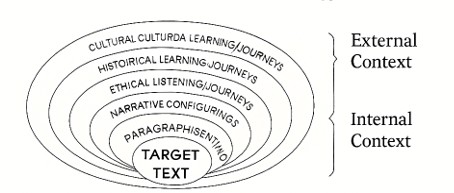
Education is never only about the transmission of knowledge. It is a field where professional identities are shaped, contested, and continually remade. To speak of professional identity in teaching is to enter a space of fluidity, where becoming a teacher is always already entangled with histories, gazes, and the precarious interplay between expression and erasure. Methodologically, hermeneutic phenomenology and narrative inquiry allow us to listen differently: to dwell with lived moments, to interpret the textures of experience, and to attend to stories not simply as acts of meaning-making but as disclosures of being-in-the-world (Heidegger, 1962). Professional identity, in this sense, is not a fixed sociological category but a horizon of becoming—fragile, unfinished, insistently disclosed (Gadamer, 2004).
The testimonies of immigrant English teachers in Australia illuminate this horizon. Their accents, pauses, and memories are not simply sociological details but philosophical provocations. One teacher recalled: “Before I even spoke, they had already rejected me.” Such words point to the ways in which identity can be reduced to a surface—skin, accent, gender, or origin. To teach under such conditions is to carry both curriculum and gaze, to wrestle with visibility and invisibility simultaneously. Hermeneutic phenomenology calls us not to dismiss these moments as anecdotal but to linger with them, to interpret their depth as tremors of the life-world, where professional identity is both bestowed and withheld, expressed and erased.
Yet these teachers do not remain silent. Their testimonies demonstrate how narration can resist erasure. “Each time I tell my story, I reclaim my place in this profession,” another participant affirmed. Words here are not inert; they are action, reclaiming space against the forces that would render them inaudible. Story becomes a mode of resistance, unsettling categories of insider and outsider, legitimate and illegitimate, native and non-native. In narrating their experiences, teachers reconfigure the very boundaries that exclude them, transforming memory into agency. Narrative, in this sense, is not simply a method but an ethical practice: it affirms expression where erasure has been imposed and creates openings for new forms of belonging.
Out of these disclosures emerges what may be called hybrid professional becoming. (Nigar & Kostogriz, 2025a, 2025b). Identity is not a badge to be worn but an unfolding practice, a continuous composition of cultural, linguistic, and affective resources into new forms of life. One teacher expressed this poignantly: “always in-between—never fully here, never fully there”. At first glance, this condition of in-betweenness may appear as a deficiency. Yet under hermeneutic attunement it reveals itself as élan vital, a generative force, a pulse of becoming that improvises with the fragments at hand. Becoming, in this sense, is not about resemblance but about invention—about opening lines of becoming that resist capture and unfold possibility (Deleuze & Guattari, 1987).
The so-called “third space” of hybridity is therefore not simply a buffer but a boundless site of emergence. It unsettles authority, bends binaries, and proliferates possibilities that could not exist within rigid categories (Bhabha, 1994). To dwell in-between is thus to inhabit ambivalence as creative potential. It is to draw attunement from dissonance, to practise an improvisatory professional work that resists both exclusion and assimilation. Professional becoming, in this light, is less about reaching stability than about cultivating an openness to movement itself: imagining oneself anew as a cosmopolitan teacher of English, unbounded by fixed categories of legitimacy.
Still, hybridity is not without cost. Stories of onto-epistemic injustice punctuate these accounts, showing how the politics of credibility operates in everyday professional life. One teacher lamented: “They spoke over me in meetings, as if my words carried less weight.” Such testimony discloses the subtle yet enduring ways that knowledge is stratified and voices are diminished. The question of whose experience matters, whose speech resonates, and whose authority is acknowledged is not a private grievance but a structural reality. Professional practice is never neutral terrain but contested ground, marked by power as much as by curriculum and the professional standards of so-called “standard English”. It is here, again, that expression and erasure meet: whose knowledge is amplified, and whose remains obscured (Fricker, 2007).
The philosophical task, then, is to hold open questions rather than rush to closure. What does it mean to become in conditions that deny your becoming? How might one inhabit the in-between without being diminished by it? Education, if it is to remain faithful to its deeper promise, must preserve its unpredictability, its openness to what cannot be reduced to outcomes or metrics (Biesta, 2013). It must remain a practice of freedom rather than conformity, an enactment of courage in the face of uncertainty (Freire, 1970/1996). These teachers embody that courage. Their lives show that education is not only the achievement of standards but the willingness to live with risk, to dwell within the unfinished, to take up identity as a practice rather than a possession.
To dwell with these narratives is to encounter not only hardship but gestures of imagination. In narrating exclusion, teachers enact possibility. Their stories sketch futures where professional identity is no longer tethered to accent or origin but emerges from solidarity, reflexivity, and imagination. To become a teacher is not to simply arrive at a predetermined category but to inhabit struggle as the ground of transformation. One is not born a professional, but becomes—through narration, through solidarity, through acts of resistance and care.
What emerges between expression and erasure is a philosophy of education attuned to both fragility and vitality. Professional identity is simultaneously philosophical and political, deeply personal yet radically collective. It is in the in-between that teachers learn not only to teach but to be otherwise—carrying within them the seeds of futures where education is less about recognition bestowed from above and more about the shared labour of becoming together.
References
Bhabha, H. K. (1994). The location of culture. Routledge.
Biesta, G. (2013). The beautiful risk of education. Routledge.
Deleuze, G., & Guattari, F. (1987). A thousand plateaus: Capitalism and schizophrenia (B. Massumi, Trans.). University of Minnesota Press.
Fricker, M. (2007). Epistemic injustice: Power and the ethics of knowing. Oxford University Press.
Freire, P. (1996). Pedagogy of the oppressed (M. B. Ramos, Trans.; Rev. ed.). Penguin. (Original work published 1970)
Gadamer, H.-G. (2004). Truth and method (2nd rev. ed., J. Weinsheimer & D. G. Marshall, Trans.). Continuum.
Heidegger, M. (1962). Being and time (J. Macquarrie & E. Robinson, Trans.). Blackwell.