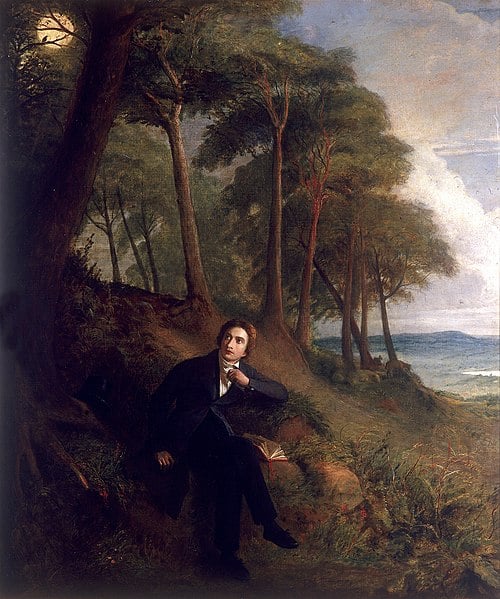
(Keats Listening to a Nightingale on Hampstead Heath by Joseph Severn, Public domain, via Wikimedia Commons)
(Above is an audio recording of the blog post)
Education should instil a certain emptiness in students. It needs to be a hunger-inducing emptiness where they never rest in the taken-for-granted but are always in a curious pursuit. This is the state of John Keats’ Poet. Yet where does that leave the shaping of the identity of the student? The curious pursuit must be guided by a principle that leads the student towards a better and wiser identity. This is the Pragmatist of William James. I argue that it is the marriage of the Poet and the Pragmatist that best combines education’s ever-questioning practice with its formative goal.
The strongest argument against the force-feeding of facts to students comes from Paulo Freire. He calls it the ‘banking’ pedagogy, led by the teacher and their deposits of facts to be carefully memorised by the students. This ‘turns them into “containers,” into “receptacles” to be “filled” by the teacher’ (Freire, 2014, p. 72). In no way does this satisfy education’s goal of a curious and critical pursuit of knowledge. Here, the teacher literally grants knowledge to be taken. The ‘banking’ pedagogy does, however, satisfy the goal of forming the identity of the students. It is a mass-produced and homogenous ‘receptacle’ identity, but an identity, nonetheless. With the purging of deposits, the question naturally becomes: who, then, are the students? They are empty. That, however, is no bad thing.
‘A Poet is the most unpoetical of anything in existence because he has no Identity; he is continually in for and filling some other Body’ (Keats, 2002, p. 188). In one of his letters, John Keats describes the remarkable gift of the Poet to inhabit all poetical creatures on this earth. The Poet can do this precisely because of their unpoetic lack of identity. Emptiness is then what lets one entertain almost anything in one’s curious pursuit. It is what lets the learner engage with all kinds of experiences by inhabiting each and every one of them. However, this apparent gift can easily become the Poet’s curse.
In The Seagull, Anton Chekhov’s fictional novelist Boris Alexeyevich Trigorin seems to suffer madly from this curse. All he sees, he must use. Everything, even the sickliest smell and strangest cloud must be stored, guarded, and put in a story. ‘I cast out for words. For phrases. And I catch them in my net. And I trawl them in and I guard them. In case they are ever useful. I’m always working. I would love to stop for a day’ (Stephens & Chekhov, 2017, p. 41). Boris’ poetic emptiness has turned on him. He has become a poetic void that sucks in all that he sees. The sheer lack of a guiding identity turns the Poet’s curious pursuit into a cursed pain. How can we save the Poet from this all-consuming void?
‘Look. Look up there. You see that cloud. I see that cloud. It looks like a grand piano. And there’s part of me that thinks, I must use that. Put it in a story’ (Stephens & Chekhov, 2017, p. 41). It is this part of Boris’ monologue that reveals the flaw in his poetic personality. Boris is compelled, doomed even, to put everything into a story precisely because he has no story of his own. All experiences simply flow through this writer because he has no guiding principle that can attach them, like beads on a string. Boris has no string. The consequence is a hailstorm of beads in poetic disarray. Boris needs a philosophy that can sort his experiences. His Poet needs a Pragmatist.
William James reorients philosophy towards the individual with his ‘pragmatism’. This new pragmatist goal is centred around what difference it will make to you whether this view or that view be true (James, 2000). It is a reorientation of the meaning of truth, not as something objective ‘out there’, but rather as something useful ‘in here’. Truth is instrumental and must be put to work in our experience of the world (James, 2000). As such, pragmatism may serve as the string Boris so desperately needs. True are those ideas which we can ride, those which can lead us fruitfully from one experience to another (James, 2000). It is a philosophy that determines which beads of experience go well with the ones that came before. The result is an organised string of experiences that is uniquely your own, an education through experience that makes you.
This is not some string of experiences that is neatly tied after one’s final graduation ceremony. Rather, it is a process of lifelong learning that continues as long as there are new experiences to be had. However, the necessary bedrock of beads must be made early on. According to James’ fellow pragmatist John Dewey, what has been learned in the past becomes instruments for grasping and understanding the experiences to come (Dewey, 1997). The first educational experiences are therefore among the most important ones. It is their organisation that will lay down the pattern for future understanding.
Education should therefore give students the string of identity. Or rather, the necessary first knot from which they can craft their own. Purged of all deposits they are ready to become empty Poets, entertaining all possible experiences on their own accord. In that poetic void, however, education must tie the Pragmatist’s string that is the foothold of the student’s emerging identity. If education is to successfully instil into the learner an ever-curious pursuit as well as form their virtuous identity, the Poet and the Pragmatist must tie the knot in a marriage of personalities.
References
Dewey, J. (1997). Experience and Education. New York: Free Press.
Freire, P. (2014). Pedagogy of the Oppressed: 30th Anniversary Edition. New York: Bloomsbury Academic.
James, W. (2000). Pragmatism and Other Writings. London: Penguin Classics.
Keats, J. (2002). Selected Letters of John Keats: Based on the Texts of Hyder Edward Rollins, Revised Edition. Cambridge: Harvard University Press.
Stephens, S., & Chekhov, A. (2017). The Seagull. London: Bloomsbury Methuen Drama.