This post can be downloaded as a PDF here
[T]here are many gendered bodies in the world and ‘male’ and ‘female’ do not even begin the hard work of classifying them. (Halberstam, 2018, p. 154)
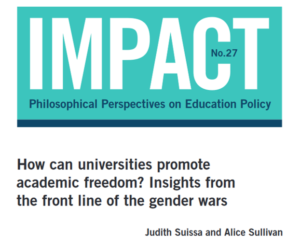
So writes Jack Halberstam in the penultimate paragraph to their book Trans*: A quick and quirky account of gender variability. Halberstam’s comment is written in the context of an epilogical reflection on the use of pronouns. In it, Halberstam refuses to state their own pronoun preferences on account of their ‘irresolvable and ever-shifting’ gender identity, coupled with their wish for more people to use a ‘pronoun system’ based ‘on gender and not on sex … on comfort rather than biology’ (2018, p. 154). Halberstam’s resistance to a ‘pronoun system’ that privileges the dimorphic (male/female), sexological categorisation of people based on biological make-up is offered in the midst of ongoing tensions in Anglo-American contexts around questions of sex, gender, feminism, and trans rights. In the context of the Philosophy of Education Society of Great Britain, these tensions have found recent expression in the ‘Impact’ publication How can universities promote academic freedom? Insights from the front line of the gender wars, by Judith Suissa and Alice Sullivan (2022).
In it, Suissa and Sullivan suggest that academic freedom in the context of universities is under threat due to a ‘new authoritarianism’ characterised by the ‘suppression’ of research, ‘no-platforming’, and a ‘chilling climate’ where ‘some political activists both within and outside universities’ are given overreaching influence (2022, p. 5). In response to those who ‘dismiss’ the ‘crisis of academic freedom’ without engaging with the details of specific cases, Suissa and Sullivan home in on current debates around sex and gender, focusing especially on the experiences of those ‘dissenting’ from what the authors refer to as the ‘orthodoxy’ of contemporary ‘gender identity activists’ (2022, p. 18). In other words, Suissa and Sullivan offer insights from the ‘front line’ of the so-called ‘gender wars’ to foreground the need to take seriously a wider attack on academic freedom in the contemporary higher education landscape. This attack, the authors claim, has stifled debate to the extent that the supposed tenets of ‘gender identity ideology’ cannot be questioned without threats of violence being made, coupled with a climate in which dissenting academics face calls for professional reprimand and dismissal by their employers.
What brings us to this long-form blog is a desire to respond respectfully to Suissa and Sullivan’s publication in the spirit of inquiry they seek to assert. As the number of claims and arguments they make are too numerous to address in a single blog, even a relatively long one, we limit our response to two issues:
- The authors’ reading of so-called ‘gender identity ideology’;
- The editorial context of the ‘Impact’ publication.
We suggest that Suissa and Sullivan’s arguments rest on a reading of contemporary queer and trans theories that fails to account for the complex ways in which questions of sex, gender, and embodiment have been taken up within these traditions of scholarship. Secondly, we focus on the editorial context of the publication, suggesting that the editorial’s emphasis on ‘cancel culture’ and ‘no-platforming’ risks falling in line with the tenor of recent government discourses that have over-inflated these trends as ‘threats’ to academic freedom, while at the same time positioning issues like racism and engagements with critical race theory as ‘attacks’ on free speech. We conclude the piece by suggesting an alternative imaginary for academic freedom premised on attending to the flesh-and-blood textures of academic life, i.e. the qualities of those relationships that make free inquiry possible, qualities like solidarity, curiosity, openness, and humility. In doing so, we hope to contribute to an academic climate in which structural marginalisation can be disrupted and collegial scholarly environments cultivated and sustained.
The authors’ reading of ‘gender identity ideology’
The first element of Suissa and Sullivan’s publication that we seek to address is their reading of so-called ‘gender identity ideology.’ Suissa and Sullivan leverage their wider academic freedom argument around a particular interpretation of gender (and specifically queer) theory, so it makes sense to start here. In contextualising some of the issues at play, Suissa and Sullivan (2022) write the following:
We will argue that current conflicts around sex and gender are not about trans rights per se, which we fully support, and which are already protected under current UK legislation, but about the imposition of ontological claims underlying a particular ideological position. Often associated with the intellectual traditions of post-modernism and Queer Theory, this position entails denying the material reality and political salience of sex as a category, and rejecting the rights of women as a sex class … (p. 7)
The ‘orthodoxy’ of gender identity ideology, the authors contend, rests on an ontological denial of the materiality of sexed bodies, and the significance of this materiality for mobilising feminist causes that have their root, in no small way, in the ‘child-bearing capacity’ of women, to quote the authors (Suissa & Sullivan, 2022, p. 39). We agree with Suissa and Sullivan that taking seriously the materialities of embodiment is crucial for feminist gains; where we differ is in their claim that queer theory enacts an ontological denial of these realities. In this sense, we suggest that the authors’ arguments rest on a reading of contemporary queer and trans theories that does not account sufficiently for how the materiality of bodies has been engaged with in these fields.
The oft-cited distinction between sex and gender (where the former indicates dimorphic biological categories, and the latter indicates the discursive effects of these on the construction of social and political life) has been read in a manner different to what Suissa and Sullivan’s interpretations permit, with some pointing to the material significance of the body in how gender hierarchies are constructed and refused. In referring to biological sex as a ‘regulatory fiction’, for example, Judith Butler (1990) does not seek to deny the materialities of bodies themselves (bodies are not literally ‘fictional’), but rather seeks to disentangle bodies from regulatory and biologically essentialist tropes often tied to the political and psychiatric mobilisation of dimorphic sexological categories. In these terms, to think of gender as performative is to recognise how ‘gender’ as a social and political regime produces (and is produced by) the discursive effects of ‘sex’-based categories like ‘male’ and ‘female’: to refer to biological sex as a regulatory fiction is to recognise, not deny, how the body is constituted within these ‘gendered’ systems of power. It is the categorising effects of ‘sex’ that queer theorists refuse to grant ontological status to, and not the embodied realities imbricated within these processes. Queer theorists problematise accounts that attempt to ‘fix’ identity (including gender identity) within essentialist logics that reify ‘maleness’ or ‘femaleness’: on our reading, they attend to how the materiality of our bodies exceeds the ‘grid’ of ‘sex’, so to speak. For queer and trans theorists, this is important in reclaiming the agency of bodies from the disembodied logics of patriarchy and heteronormativity, and in exposing the ways in which dimorphic categories have been essentialised (and ontologised) to justify sexism, misogyny, homophobia, and transphobia.
In this vein, the agentic materialities of the body have been foregrounded at the intersections between queer/trans theories and feminist new materialisms. In his book Queer Embodiment: Monstrosity, Medical Violence, and Intersex Experience, Hil Malatino (2019) emphasises the ontological inseparability of materiality and the discursive construction of social phenomena:
Materiality and discursivity … are understood as ontologically inseparable, which means ‘body talk’ is a transformative social and political force, not merely imprinted or moulded and not ever able to be neatly relegated to a place beyond, outside, or squarely in the margins of the social. (p. 210)
Put differently, the materiality of the body cannot be ‘erased’ or reduced to a passive effect of discursive practices, as some gender critical feminists might suggest of queer theory. It is in these terms that Malatino quotes the work of feminist new materialist Karen Barad, who writes of matter as being more than a ‘mere effect of discursive practices, but rather an agentive factor in its iterative materialisation.’ In other words, matter matters: our material lives are not only shaped by social discourses, but also necessarily shape the construction and resistance of those same discourses too. In this sense, our bodies play an active role in processes of intra-action: they have social and political force and cannot be ignored in how we think about the world. Bodies, so conceived, are not inert, but alive, participating in vital ‘iterative’ processes of world-building, to use our own phrasing.
In taking this intra-active, material ontology seriously, Malatino seeks to reclaim the materiality of the body from the streamlining effects of dimorphic sexological categories, categories that fail to do justice to the complexities of our embodied lives to begin with. Put differently, lived, bodily experience (materiality) is always far more complex and in excess of medicalising discourses. In these terms, by relocating ‘sex’ from something within the body to something that occurs as a regulatory fiction (to use Butler’s wording again) between bodies, Malatino preserves the material specificity of the body and its role in social and political life, while at the same time creating an opening for the diversity of these embodied realities to be exposed and built upon rather than erased. This point is central to feminist theories, and in this way foregrounds the false dichotomy often set up by gender critical theorists between feminist and trans theories. Indeed, both theories rely on the same critique of stable meanings of embodiment and on the need to consider the material effects of embodiment through experience, politics, and discourse.
Returning to Suissa and Sullivan’s claim, then, we feel it is a misreading to suggest that the material realities of sex are erased within queer theory: queer and trans theorists do not deny the materialities of our embodied lives. Rather, they resist privileging the streamlining effects of sexological dimorphism when it comes to how those very same materialities are understood in the reproduction and refusal of gendered hierarchies. In this sense, such categories collapse under the weight of the material realities they signify. Once again, as Halberstam writes, ‘there are many gendered bodies in the world, and ‘male’ and ‘female’ do not even begin the hard work of classifying them.’ For us, this point is politically salient in exposing the limits of biological dimorphism and biological essentialism, and in building alternative ways of living that refuse the pernicious effects of these. Again, this is a key concern of feminist theories too.
The editorial context of the ‘Impact’ publication
As well as engaging with Suissa and Sullivan’s views, we feel there is a need to respond to what is a rather unusual endorsement of the argument by the publication’s editor, and also the Chair of the Philosophy of Education Society of Great Britain, Michael Hand. On the threats posed by so-called ‘cancel culture’ to academic freedom, Hand suggests that ‘when we look closely at the “contemporary reality of suppression of debate on sex and gender”, there can be little doubt that the crisis is real’ (p. 3). All IMPACT publications include the editorial disclaimer that the pamphlets
express the ideas of their authors only. They do not represent the views of the Philosophy of Education Society of Great Britain. The Society has several hundred members whose ideas and political allegiances are widely disparate. (p.4)
While Hand does not, then, position the pamphlet or his editorial as representative of the society he chairs, we are nevertheless concerned that it could misread as such, given the highly politicised and divisive nature of the pamphlet’s subject-matter. As two members of that society, we seek to make good on the editorial disclaimer quoted above, and to demonstrate a strong divergence of opinion on this issue, particularly considering the wider context of the publication itself.
In his introduction, Hand cites former education secretary Gavin Williamson’s claims that ‘The rise of intolerance and “cancel culture” upon our campuses… directly affects individuals and their livelihoods’ and that high profile incidents of academics and students being “forced to live under the threat of violence” are “but the tip of an iceberg”’ (p.2). In response, he then cites a claim from Jack Ballingham, a Student Union Officer at the University of Durham, that the ‘problem [of ‘cancel culture’] … is “largely confected” … “generated by a media class intent on whipping up a moral panic around academia and universities”’ (p. 3). These comments made by Williamson and Ballingham are with reference to the Government’s Higher Education (Freedom of Speech) Bill, which was first introduced by Williamson and is, at the time of writing, at report stage in the House of Lords.
Hand argues that the question at issue between Williamson and Ballingham is ‘whether the “rise of intolerance and cancel culture” in universities is as steep or as troubling as the Government suggests’ (p. 2). As mentioned above, he goes on to assert that ‘when we look closely at “the contemporary reality of suppression of debate on sex and gender”, there can be little doubt that the crisis is real. The evidence catalogued by Suissa and Sullivan of suppression of research, of blacklisting, harassment, and smear campaigns, of no-platforming, disinvitations and shutting down of events, is incontrovertible’ (p. 3). For Hand, then, the evidence catalogued by Suissa and Sullivan is sufficient to resolve the disagreement between ‘the Government’ and Ballingham. But in focusing on how ‘steep’ the problem appears to be, Hand has ignored an important element of Ballingham’s position which is not about dismissing intolerance, threats of violence and risks of job loss (we condemn all such incidents along with Suissa and Sullivan) but also about whether this is all that we should find ‘troubling.’ In his blog, Ballingham asserts that ‘What must be understood is that this is not a matter of problems and solutions. It is a matter of pretexts and action.’ He further argues that that ‘the government, quite simply, views higher education as a source of dissent,’ and that ‘By passing this Bill, more power will be foisted upon the Office for Students, a body which will be further politicised by the new “Director of Freedom of Speech and Academic Freedom”’ (Ballingham, 2021). Ballingham interprets the Free Speech Bill in light of ‘the wider context of the government’s legislative agenda’ – such as (for example) the Police, Crime, Sentencing and Courts Bill, giving Police increased powers over protest and increasing the penalty for vandalism of public monuments.
There also seem to us to be resonances between the government’s attention to ‘free speech’ and their interpretation of ‘political neutrality’ in schools, which has led to guidance that ‘white privilege’ must always be taught alongside a ‘balanced treatment of opposing views’ (Murray, 2020), that ‘Black Lives Matter’ cannot be promoted by teachers (Turner, 2022), and that ‘anti-capitalism’ is an extreme political stance’(Mohdin, 2020). In the more specific context of Higher Education, universities have been encouraged by Ministers to reconsider their commitments to charters and schemes such as Advance HE’s Race Equality Charter, Stonewall’s Diversity Champions and Workplace Equality Index, and Athena Swan (Dickinson, 2022). In a letter to university Vice Chancellors on 27th June 2022, the then Minister of State for Higher and Further Education, Michelle Donelan, specifically mentioning the Race Equality Charter, reminded colleagues of the regulatory role of the Office for Students, and ominously warned, ‘Bearing in mind the substantial sums invested by the taxpayer into Higher Education, I would ask you to consider whether membership of these schemes; the initiatives that flow from them; and the creation of new, highly paid, management roles in these areas truly represent good value for money for taxpayers or students.’ Commentators have observed a strong disincentive here for universities to take value stances in support of minoritized members of their staff and student bodies (Dickinson, 2022).
Viewed in this context, it is clear to us that far from being ‘incontrovertible’, the catalogue of examples assembled by Suissa and Sullivan does not resolve the disagreement between Ballingham and Williamson, so it is odd that Hand should frame Suissa and Sullivan’s examples in these terms. Indeed, the ‘incontrovertibility’ of ‘no-platforming’ on campuses is not quite as clear-cut as is often supposed, with research by the Office for Students suggesting it occurs only on a very limited basis. Of more than 62,000 requests by students for external speaker events in English universities in 2017-18, for example, only 53 were rejected by the student union or university, less than 1 percent of the total (The Office for Students, 2019, pp. 10-11). Moreover, it has not been made clear to us how any such catalogue of examples, however comprehensive, would be sufficient to refute the claim that the Free Speech Bill will serve to curtail, rather than promote, students’ and academics’ freedom to express or campaign in support of their views. We do not pass any comment on the veracity of the examples assembled by Suissa and Sullivan, though it is worth reiterating our unequivocal condemnation of any personal threat of violence or harassment experienced by any academic engaging in their work. In light of this, we also observe that no examples are offered in the publication of comparable harms sustained by trans, or trans-identified, students, academics, or activists. We are thinking, as one example, of the experiences of academic Lori Watson (2016), a cisgender woman who rejects a trans-excluding feminism partly because of the violence she has experienced for simply being (falsely) identified as trans by others at work (in spaces like university bathrooms, for example).
Given that the outcome of Suissa and Sullivan’s argument, in Hand’s view, is to support the Government’s proposed Bill, we ultimately wonder whether justice has been done to the balance of power in this situation, specifically the power between the political establishment on the one hand and the protesting power of academics, students and student unions on the other. In these terms, Hand does not consider the wider political context that is Ballingham’s primary concern. And nor does he consider the potential of the Bill to constrain academic freedom whenever it does not align with the values or ideologies of the Government – the exact opposite of what Hand and the Impact pamphlet call for. We raise this, not only with respect to Hand’s editorial (where the matter is declared decisively in favour of the former Secretary of State for Education, rather than the SU Executive Officer) but in terms of a broader concern about whether the ‘independent’ regulator, the Office for Students, really seeks to act for students, or whether it seeks rather to proscribe the range of issues on which they might protest or petition their universities.
Academic freedom and the pursuit of truth
While we have emphasised in this blog points of disagreement between ourselves and Suissa and Sullivan, it is important to stress certain points of contact in our thinking, specifically around the question of academic freedom. Indeed, we concur with the authors that academic freedom ‘involves moral, political and conceptual questions’ (p. 8), and we also share their sensitivity to the threats to academic freedom posed by academic precarity, instrumentalist accounts of education, and consumerist logics that have ‘allowed universities to lose sight of their purpose in pursuit of the bottom line’ (p. 41). We are also sympathetic to their recommendation that universities maintain pluralistic spaces of inquiry and collegiality that are antithetical to harassment: indeed, the freedom to engage in academic work cannot be enabled without a serious commitment to sustain cultures in which disagreement is recognised as par for the course.
Whereas Suissa and Sullivan frame these commitments around an understanding of academic freedom tied to ‘the pursuit of truth as the core principle underlying university education and research’ (p. 47), we wish to focus also on the quality of relationships necessary for free inquiry to happen. We engage in this shift of emphasis, not to lose sight of the role pursuing truth (or, indeed, any other kind of aim) may or may not play in academic life, but rather to bring to the fore those flesh-and-blood textures of academic life that might otherwise be flattened when academic freedom is framed solely in terms of a telos to be ‘rigorously’ achieved. Specifically, we have in mind those relationships between students and academics, and academics and administrators, etc., upon which our capacity to freely inquire often depends, relationships of solidarity, curiosity, openness, and humility, for example. In this respect, Butler’s work on academic freedom is instructive. Butler maintains that ‘academic freedom implies a right to free inquiry within the academic institution, but also an obligation to preserve the institution as a site where free inquiry can and does take place’ (2017, p. 857 ). In thinking about academic freedom with Butler, we foreground relationships, and the qualities needed to productively sustain them, in order to evade reducing our interactions in the academy to mere footnotes to the wider academic pursuit of truth.
To concretise these ideas, allow us to illustrate with reference to an experience one of us has had in a classroom setting. Seán was teaching a module introducing student teachers to philosophical and sociological perspectives on education. A few weeks into the module, a conversation in class digressed into a debate on sexism in education, specifically in relation to the exclusion of women from STEM education and STEM fields. One male student in the class (who we pseudonymise as John) took exception to several claims made by his peers, arguing that sexism was not a structural problem in STEM fields today given the existence of gender quotas within research schemes, and the support many young women receive to advance in STEM (through, for example, school/university access channels, etc.) The debate became heated, with many women in the class challenging John on his views, some vocally, and others through the chat function of our virtual learning environment (classes were online at this point due to ongoing coronavirus protections). A week later, some of the women who challenged John lodged complaints to Seán against him, on the grounds that John had proceeded to make sexist comments about one of the women in a private social media group chat. In the process that followed, Seán met with John to discuss what had happened and the context around it. During this discussion, John shared with Seán how he felt classroom spaces should be spaces where ideas can be rigorously debated, no matter how offensive or otherwise some ideas might be. Nonetheless, he verbally acknowledged the harm caused by his sexist social media comments and committed to apologising to the woman he had harassed.
Weeks passed and all seemed well, until the very last class of the year, where students were sharing with each other their ideas for the end-of-semester assignment. John shared with the group that he planned to write his paper on misandry in education, with a particular focus on how education systems supposedly privilege girls and women at the expense of boys and men. A few hours after the session, Seán received an email from one of the other students in the class, who claimed that John’s choice to write an essay on misandry in education was unacceptable, and that it betrayed an attitude that risked causing harm, not only to John’s classmates, but to John’s future pupils. Seán’s response to his student was: it was John’s academic freedom as a student to write about whatever topic he wished and that all student submissions would be graded against the criteria set for the assignment.
One immediate point that comes to us in reflecting on this experience was the appeal Seán made to academic freedom as a response to his student’s concerns. In framing John’s academic freedom as a justification for his choice of topic, Seán fears he granted legitimacy to an understanding of academic freedom divorced from any sense of responsiveness to others or to the particularities of specific contexts: Seán’s framing gave priority to John’s ‘right’ to pursue misandry as a line of inquiry, irrespective of his colleague’s potential issues with this. Indeed, the sexist events that had happened that semester were not separate from the theme of John’s essay, and his choice to pursue it betrayed, at best, a lack of sensitivity to the experiences of his classmate that he had harassed. Irrespective of why he chose that topic, however, John’s decision was certainly not one that displayed any sense of receptiveness to the upset he had caused others, or to the obligations he might have had to learn from his colleagues. We share this example, not to suggest a fixed rule of thumb on whether or not John ‘should’ have written an essay like this, but rather to illustrate the context-bound nature of inquiry: our freedom to ask questions, think differently, share experiences, and articulate ideas does not occur in a vacuum, but is instead a necessarily relational practice that is as much grounded in our responsibility to others as it is in our right to ‘pursue truth’. John may have wished to pursue the (obviously false) ‘truth’ of education’s structural misandry, but that pursuit certainly blinkered him to the experiences and sensitivities of his peers. In this way, John’s approach to his academic work, and Seán’s earlier framing of it, speaks to the observations of Alexis Gibbs, who has indicated how ‘disputes over academic freedom have become … more concerned with the freedom to offend than … with the freedom to listen and understand’, where ‘the indulgence of speaking’ matters more than ‘the exercise of listening’ (2021, p.22, p. 38).
Returning to Suissa and Sullivan’s publication, we share their view that academic freedom is under threat, and we also join in solidarity with them in condemning threats of violence against scholars who engage in teaching and in the dissemination of research. However, addressing that threat, we contend, can be achieved less by valorising the pursuit of truth above all else, and more by attending to the textures of academic life that enable us to inquire together. Such attention includes a responsiveness to experiences of trans communities, taking seriously how trans people have been structurally marginalised within academic and wider spaces. It also relatedly involves taking seriously sexist violence and abuse: for us, there is no binary or either/or between these concerns. For it is patriarchy, and its efforts to elide, ignore, violate, and streamline our material lives, that acts as the significant threat to academic freedom in our contemporary times.
*[This post was first published 18 December 2022 and was revised 28 April 2023]
Bibliography
Ballingham, J., 2021. Universities should oppose, not just refine, the Free Speech Bill. Wonkhe, 13th October 2021. https://wonkhe.com/blogs/universities-should-oppose-not-just-refine-the-free-speech-bill/
Butler, J., 1990. Gender Trouble: Feminism and the Subversion of Identity. New York: Routledge.
Butler, J., 2017. Academic Freedom and the Critical Task of the University. Globalizations, 14(6), pp. 857-861.
Gibbs, A., 2021. A responsibility to seek the truth: Revisiting Averroe’s decisive treatise for academic freedom’s missing imperative. Philosophy and Theory in Higher Education, 3(1), pp. 21-40.
Halberstam, J., 2018. Trans*: A quick and quirky account of gender variability. California: University of California Press.
Malatino, H., 2019. Queer Embodiment: Monstrosity, Medical Violence, and Intersex Experience. Nebraska: University of Nebraska Press.
Suissa, J. & Sullivan, A., 2022. How can universities promote academic freedom? Insights from the front lines of the gender wars, s.l.: Wiley/Philosophy of Education Society of Great Britain.
The Office for Students, 2019. Prevent monitoring accountability and date returns 2017-2018: Evaluation report. [Online]
Available at: https://www.officeforstudents.org.uk/media/860e26e2-63e7-47eb-84e0-49100788009c/ofs2019_22.pdf#
[Accessed 2 December 2022].
Watson, L., 2016. The Woman Question. TSQ: Transgender Studies Quarterly, 3(1-2), pp. 246-253.
Turner, C., 2022. Don’t promote Black Lives Matter to pupils, teachers told, in crackdown on politics in the classroom. The Telegraph, 16th February 2022. https://www.telegraph.co.uk/politics/2022/02/16/dont-promote-black-lives-matter-pupils-says-new-guidance-schools/