One of the most awkward parts of attending conferences, or indeed any work related event, is the requirement to explain what I do. On the train from Sheffield to Oxford for the PESGB annual conference, I was still unsure how best to articulate this and was very much hoping to stay under the radar. It wasn’t that I wasn’t looking forward to the conference. After all, I had applied for a teacher bursary. It’s just that I’m not a philosopher, I haven’t really studied much philosophy and if I’m honest, I couldn’t really name one philosopher of education – John Dewey, Gert Biesta? Do they count? So why, you might reasonably ask, had I gone to this conference at all?
I’m not going to lie – the allure of the location was irresistible. The University of Oxford college setting lived up entirely to my expectations – inspiring and intimidating in equal measure. The context certainly made this conference feel more intellectual and less corporate than others I have attended recently. But aside from the opportunity to immerse myself in the set of a post-war detective mystery drama, I was also hoping the conference would be fruitful for my current work and study. I am a teacher by profession (trade?), practicing in state secondary schools as a history teacher and school leader for 15 years. Whilst coming to the formal study of philosophy of education later than most, I spent my career considering issues I now realise are important philosophical as well as pedagogical questions.
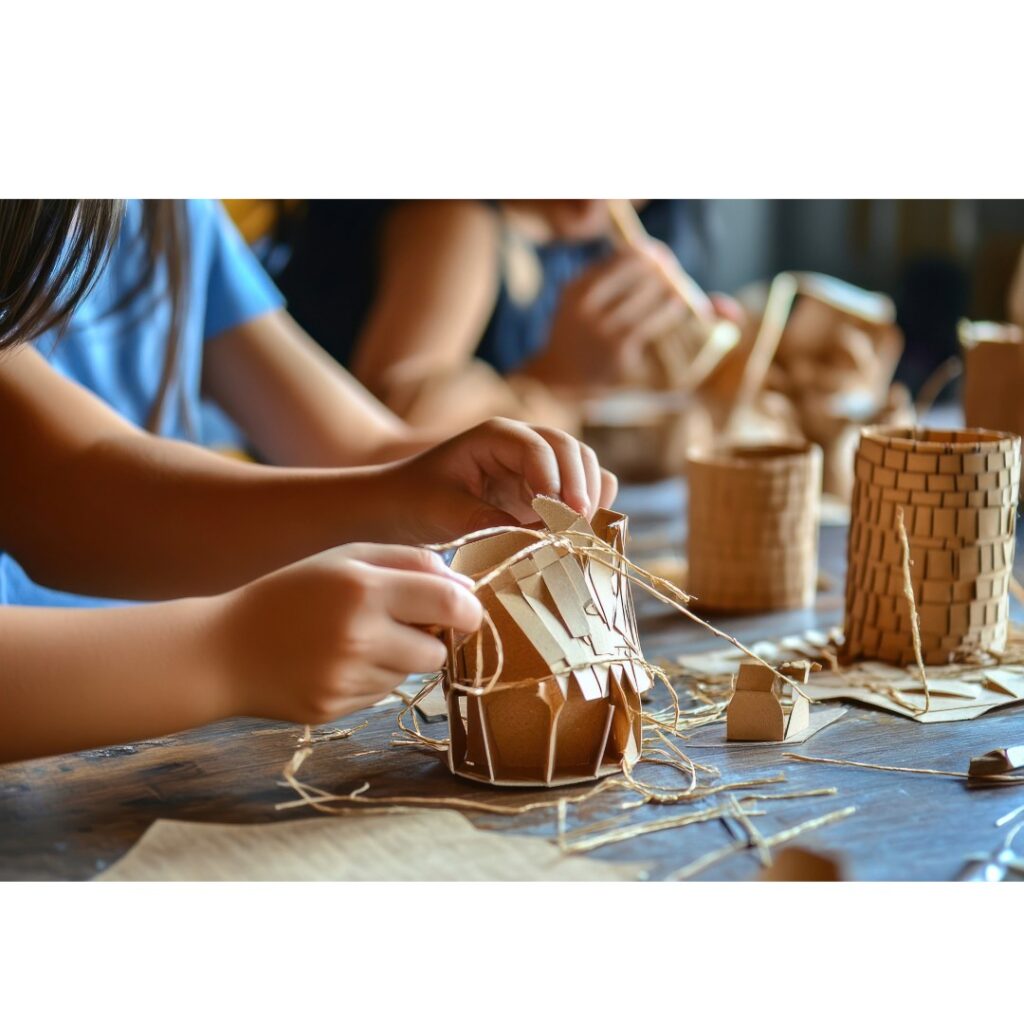
Currently I’m working on the Maker{Futures} programme at the University of Sheffield. I work alongside teachers and with researchers to see what happens when students make artefacts – both as Papert’s ‘objects to think with’ and as a language with which to communicate. Maker pedagogies promote a circular approach to education, and highlight the value of struggle, risk and slowness. Some teachers we have worked with have spoken about finally getting to know children they have taught for months through making. For others, it has revealed the disconnect between the job they thought they were doing versus the one they actually are. But the questions teachers ask most of all are often about how making might ‘give’ children 21st century skills and ‘make’ them more prepared for the jobs of the future. This both troubles and interests me. My response to this has been to gently re-focus the conversation towards the educational value of making for students and teachers. But how to articulate this in a theoretically grounded way such that it doesn’t sound woolly, impractical or unconvincing isn’t quite at my fingertips. Maker{Futures} is part of the school of education in a social sciences faculty that has few academics who would identify as philosophers, so the work we have done so far is more empirically driven than theoretically reasoned. The more work I do with making, the more I see its potential to challenge much of what is taken for granted in education and the more I have come to realise that empirical study alone will not suffice.
The pre-conference programme involved a walking methodology led by Graeme Tiffany and started with the dreaded ice-breaker activity- but this one actually kept up its end of the bargain. We were to write down two questions, one about philosophy and the other about walking. Being a novice philosopher, my question – is philosophy just making stuff up? – was only partly asked in jest. It was met with some interesting answers and it really did help to get to know people without having to ask or explain what one does. Being able to physically move around outside to talk to people had a significant impact on how dynamic, relaxed and easy the activity was. From here, the conference went in a hundred different directions and it is difficult to pull all the strands together here but I have chosen three sessions to reflect on and show how I connected the philosophy to my work.
“Become who you are!” Nietzsche’s Thus Spoke Zarathustra
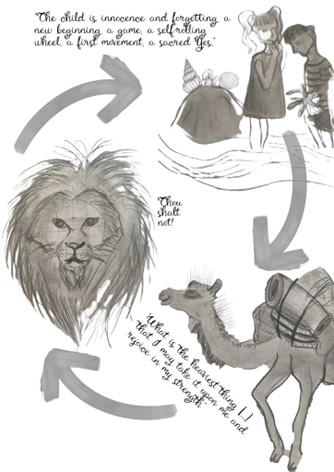
I had high hopes for the first session. It didn’t disappoint and I have been reflecting on it ever since: On the three metamorphosis of the teacher, Louise Vincent used Nietzsche’s Thus Spoke Zarathustra– to explore the potential value of a cyclical approach to teacher’s self-cultivation. One where teachers can embrace the different stages of the camel, lion and child in a continual process of overcoming. The heuristic might usefully be employed as a tool for critiquing the prevailing linear model of professional development, one which requires development opportunities to have immediate impact measurable outcomes. Applying this to my work, I reflect on how, generally speaking, it is experienced teachers who are more readily able to dwell in the child phase when working with maker pedagogies. They are more comfortable in adapting the curriculum, embracing complexity and harnessing struggle. They can make space to return to projects later rather than holding fast to the pernicious freight train of ‘coverage’ with its hit and run tactics ticking tasks off a list. However, what I’m also seeing is that for those teachers in this child phase, the willingness to engage in playfulness and uncertainty comes at an increasingly higher cost personally and professionally. Perhaps the question I will pursue further in my work is how maker pedagogies might support teachers to become confident and content in holding all three stages of the metamorphosis simultaneously.
What enables us to lead fully and truly human lives?
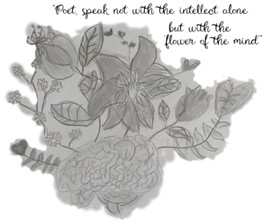
On Saturday morning I enjoyed a symposium based on the work of Japanese educator and Buddist philosopher Ikeda Daisaku. Each of the four presenters shared an aspect of Daisaku’s work. Riya Kartha considered teacher cultivation of the ‘greater self’ or taiga as a ceaseless interplay between the self and other. This again highlighted the inadequacies of dominant constructions of professional development. Kartha argued that teacher development rejects the personal dimensions of a teacher’s inner life. This denies the coexistence of the heart, mind, body and spirit which is crucial for compassion and wisdom and leads to the ‘lesser-self’ or shoga characterised by personal desires and indifferent to suffering. Giulia Pellizzato explored the role of poetry in education. She argued that the regenerative power of literature is obliterated from teaching and learning and used Ikeda’s reference to Emmerson’s The Poet to balance the intellect with intuition – “the flower of the mind”. This speaks to my work at Maker{Futures} where we provide a contemplative space for students to express their ideas that may otherwise be difficult for them to articulate using language.
“If all else fails, find a good book and adopt a dog” Shuffleton’s keynote final remarks
The keynote on Friday was given by Amy Shuffleton After the Revolution: Education and the Power of Disappointment. Shuffleton used Mary Shelley’s Frankenstein to dig into the dangers of false hope and despair and instead valuing disappointment. In schools when we make artefacts, we have to think about the inevitable disappointment that comes with working with objects in the real world. The educational value of disappointment has been hijacked by the pervasive emphasis on perseverance and resilience which works as a controlling force to silence legitimate responses. Shuffleton argues that disappointment can offer a way forward that doesn’t rely on false hope or debilitating despair. When students make artefacts they are continually reorienting their work in response to the physical boundaries – including materials, skill, time etc. This process of reorientation keeps them in continual communication with hope and disappointment. It provides a challenge to the way education individualises students, especially during practical activities, where they are required to reflect on how their artefact was planned and the extent to which it achieved a predefined aim through the imposition of their will onto the world. Through engaging with maker space pedagogies, the responsive, relational and intuitive aspects of creativity that come from being in dialogue with the material world are brought into view. The consequence of this is the ability to experience as Biesta would put it – being in the world but not at the centre of the world. This isn’t easy for teachers. Overall, I won’t be following Shuffleton’s advice and adopting a dog but I will be taking disappointment forward into my work with teachers.
One final thought relates to a conversation I had over lunch with my teacher bursary colleagues about the impact of philosophy on education policy. We all agreed that teachers engage with philosophy in their everyday practice without necessarily naming it as such. However, we also recognised that the extent to which philosophy is brought to bear on education policy is less easy to identify. Perhaps we need to provide more opportunities for accessible philosophy of education courses and conferences using blended approaches to CPD? We also considered addressing current educational issues through a philosophical lens – a PESGB podcast or YouTube? Did I find out whether philosophy was just making stuff up? Well, perhaps it partly is. But following the conference, I am more convinced than ever that the beating intellectual heart of Maker{Futures} is indeed rooted firmly in philosophy.