
The War on Science edited by Lawrence M. Krauss
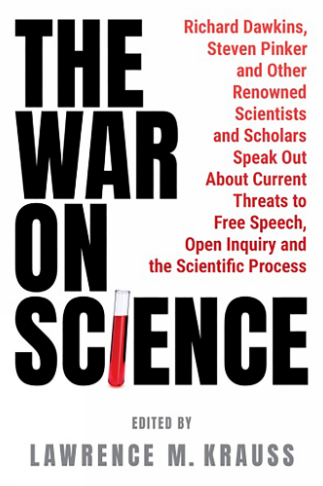
Book cover for Krauss (2025). Taken from the Forum catalogue.
Forum, 2025.
ISBN: 9781800756182, Hbk.
ISBN: 9781800756199, eBook.
RRP: £16.39 / £14.99, 304pp.
Lawrence Krauss is a distinguished theoretical physicist who has held professorships at Yale, the Australian National University and the New College of the Humanities, and his academic standing has no doubt helped him to bring together such a glittering array of scholars from all corners of the academy. Most are US academics addressing issues of particular concern to contemporary American higher education institutions (HEIs) – these include Jerry Coyne, Niall Ferguson, and Nicholas Christakis – though there are also some British scholars such as Richard Dawkins, Judith Suissa and Alan Sokal who are concerned to address similar issues affecting universities on this side of the Atlantic.
The overriding theme of this collection is outlined by Krauss as a concern that Universities and science institutions in the West are unfortunately no longer guaranteed to be places where the free and open exchange of ideas is encouraged, nor where scientific progress can be carried out unhindered by ideology (p. 8). The principal offending ideology is the diversity, equality and inclusion (DEI) policies of universities which have expanded into vast bureaucracies which control all aspects of academic life from admissions and recruitment to learning, teaching and curriculum matters. Krauss regrets the fact that questions ranging from the difference between sex and gender, to the question of whether indigenous science warrants the name, are often forbidden to even be raised in the classroom or in academic meetings (ibid.)
Ideological positions on sexism, racism, gender and socio-economic justice are all implicated in the circumscription of free speech and open inquiry, with ‘deconstructionism’ and ‘postmodern gobbledygook’ contributing to the gross mutation of research, truth and knowledge in all disciplines. The chief concern – we could say, the principal anti-war aim – is to attack DEI policies at all levels by demonstrating the dangers that the irrational and relentless imposition of such race, gender, class and ethnic restrictions pose for academic discourse and the pursuit of truth in all disciplines. DEI is referred to negatively 105 times throughout the book and defines almost all the chapters. The charges against its autocratic implementation and policing by university bureaucracies – often establishing their own powerful and unaccountable fiefdoms – are grave and worrying. Illustrations abound from every discipline, from the inability of departments to recruit the best candidates for posts because White and Asian academics are ruled out, to the need to tailor grant applications to satisfy the latest inclusion or anti-racist criteria, to the impossibility of researching certain topics (gender and race in particular) because of the danger of infringing DEI requirements.
Apart from the fact that such policies are often vaguely defined and have poor evidential support, their (often well meaning) implementation can lead to outrageously counter-educational outcomes. From the ‘decolonization of mathematics’ (John Armstrong), to the ‘ideological subversion of biology’ (Jerry Coyne and Luna Maroja), to the recent ‘gender wars’ (Judith Suissa and Alice Sullivan), the unthinking implementation of the latest DEI criteria may lead to ludicrous unintended consequences, often, ironically, resulting in outcomes which achieve the opposite of the policy aims. The leading science journal Nature, for example, recently jumped on the critical social justice bandwagon by declaring that its editors will reject any articles which may generate ‘racism, sexism, ableism or homophobia’ (p. 31), and the Journal of Chemical Education was happy to publish a piece on ‘feminism and science as a tool to disrupt the dysconscious racism in STEM’ (p. 15).
To be sure there are some hyperbolic cases here and a few straw men but also some seriously concerning intellectual crimes. The gender wars outlined by Suissa and Sullivan, for instance, demonstrate the truly frightening impact that transgender pressure groups like Stonewall, which demand affirmation of the mantra ‘trans women are women’ with explicit and repeated calls for ‘no debate’ (p.269), have on HEI staff and students. The scandalous and notorious case of Kathleen Stock who was forced out of her philosophy job at Sussex by such relentless and irrational campaigning is chillingly told in Material Girls (2021). On this and similar issues, it is tempting to side with Niall Ferguson as he rants about the contemporary ‘treason of the intellectuals’ (pp. 93-104), and to endorse Richard Reddings’ plea for a ‘revolutionary reform of the professoriate’ (pp. 321-28) to counter the monstrous crimes and misdemeanours in certain areas of the academy.
Given all this, I would want to offer some sceptical challenges to the dominant epistemological paradigm of academic practice foregrounded in most chapters. The model is the well-known scientific model of truth championed by Krauss in his Introduction (pp. 8-37) and by Richard Dawkins in his mantra that ‘scientific truth stands above human feelings and politics’ (pp. 39-79):
‘Science is the jewel in humanity’s crown … we have every right to take pride in it … The facts to which science aspires are true, not just here and now for us to see, but through all time and through every distant reach of the universe where there are not, nor ever will be, eyes to see them’ (pp. 43-44).
We can accept without much qualification the power of the scientific method and its momentous achievements since the Renaissance, but still point out the drift to simplistic, disingenuous scientism in Dawkins’ hyperbole. We need not endorse the whole of Paul Hirst’s forms of knowledge thesis (1974) to acknowledge that there are alternative ways of knowing as equally important as a strictly scientific approach. It is also worth pointing out – as Rupert Sheldrake does (2012) – the anomalies and shortcomings of the materialistic scientific paradigm which leaves unanswered questions about consciousness and its place in the cosmos. Such questions have been tackled in recent times by scientists and philosophers such as Donald Hoffman and Bernardo Kastrup (Hyland, 2024) who offer non-materialist and neo-idealist answers to the hard problem of consciousness, and present viable alternatives to the mainstream scientific paradigm championed by Krauss and colleagues.
Notwithstanding such caveats, Krauss has gathered together some valuable insights here and educators can learn much from the recommendations for the improvement of practice in relation to academic freedom and open inquiry. Ironically, many of the DEI policies criticised throughout the book are now being systematically dismantled by the Trump administration. The book was obviously written just prior to this development but Krauss initially sees this as a ‘very welcome change’ (p. 12). The governing bodies of Harvard, MIT, Brown University, and others might wish to disagree with Krauss on this matter as they mount a legal challenge to the new directives (Garisto, Witze & Ahart, 2025), and eventually many others might regret the replacement of one set of ideological restrictions with another which shows every sign of being far more damaging – not just to academic freedom – but to the whole well-being and moral fabric of society.
References
Garisto, D. Wtize, W. & Ahard, J. (2025, October 21). How scientists are pushing back against Trump’s funding ‘deal’ for universities. Nature. https://www.nature.com/articles/d41586-025-03427-4
Hirst, P.H. (1974). Knowledge and the Curriculum. London: Routledge & Kegan Paul.
Hyland, T. (2024). Morality, Neo-Idealism and Conscious Realism. London: Dodo Books.
Sheldrake, R. (2012). The Science Delusion. London: Coronet.
Stock, K. (2021). Material Girls. London: Fleet.
