Against the Machine: On the Unmaking of Humanity by Paul Kingsnorth
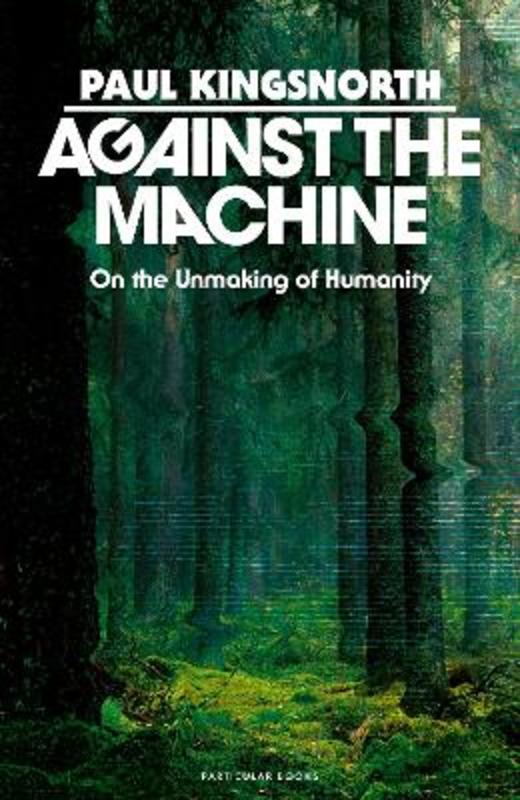
Book cover for Kingsnorth (2025). Taken from the Particular Books catalogue.
Particular Books, 2025.
ISBN: 9780241788400, Hbk.
ISBN: 9781837310975, Pbk.
ISBN: 9781837310982, eBook.
RRP: £25.00 / £12.99, 304pp.
Paul Kingsnorth has had a varied career, embracing journalism, environmentalism, and the publication of three novels (including the recently republished The Wake, which is extraordinary, not least for being written in a form of Old English). He was baptised into the Romanian Orthodox Church in 2021. He is a man not afraid to change his mind, and has pursued a long intellectual and spiritual journey, allowing his understanding of his self and his place in the world to shift and develop. Against the Machine is presented very much as a detailed defence of his current stance. It is, above all, a perceptive account of the malaise of modern society, the statement of someone out of sync with their times. Yet, while I suspect that I share many of Kingsnorth’s misgivings about contemporary society, this can be a disquieting read, as it explores the implications of finding an alternative to a world homogenised by globalisation, and driven by the goals of technological and economic progress.
At the book’s core lies the argument that contemporary society can be characterised in terms of the ways in which technology undermines the freedom of individual humans, and more radically that this technological society has led to the destruction of any profound sense of meaning in our lives. Modernity has torn up the roots that once bound us to our past and to our ancestors, not least in that there are no longer any satisfying stories or myths that allow us to make sense of ourselves, be it as individuals or as social and historical beings.
Kingsnorth draws on an impressive range of thinkers and writers who have articulated similar concerns, from philosophers (for example, Alasdair MacIntyre and Simone Weil), through social theorists (Jacques Ellul and Lewis Mumford), to theologically or spiritually oriented authors (René Guénon and Nikolai Berdyaev). Kingsnorth omits some key thinkers: Max Weber gets barely a sentence; Jürgen Habermas and Charles Taylor nothing at all. Given also the tenor of Kingsnorth’s argument, surprisingly there is no engagement with John Ruskin or William Morris. But there is something sobering about recognising the number of thinkers who have railed against the ‘malaise of modernity’ (to use Taylor’s phrase), and yet the problem only seems to get worse.
The Machine is, put bluntly, the fundamental organising principle of the modern world. It is the embodiment and product of the rationalism of the European Enlightenment, and as such manifest not simply in the rise of technology and the dogmatic assessment of social success in terms of technological progress, but also in the underpinning attitude to science, and the priority of natural scientific materialist reductionism over all other claims knowledge. Entwined with this is another dogma, that of economic progress. A growing GDP trumps a meaningful or happy life. The world is thus quantified, and through that quantification both the natural and social worlds can be manipulated and controlled. Quality, and thus meaning, counts for little or nothing.
The consequences of the rise of this Machine include, for Kingsnorth, the destruction of any communal sense of history or place. The narratives that once sustained our links to the past — to our ancestors — are rendered irrelevant. Across the globe, people live increasingly homogenous lives as urbanism and consumerism spread. To escape the Machine, to get off grid, becomes increasingly difficult. Technology also destroys nature, in the sense that nature becomes a mere resource that can be manipulated endlessly, without respect for any inherent limits or essence within it. This is as true, Kingsnorth argues, for human nature as it is for the external world. Technology destroys inherent, natural, limitations. There is no problem for which there is not a technological solution (including the ecological crisis). Billionaire tech-entrepreneurs entertain absurd technological fantasies about human immortality and the colonisation of space.
The Machine ultimately changes what it is to be human. We shift from understanding ourselves as communal beings, embedded in history and tradition and a sense of place, to becoming isolated selves — consumers, focusing on our (predominantly sexual) pleasures and who, through the application of technology, can remake and change ourselves endlessly. As Kingsnorth summarised this, past, people, place, and prayer, have been replaced by science, self, sex, and screen.
As noted, Kingsnorth draws on a wide range of significant and insightful thinkers to make his case. At his best he highlights important issues. The increasingly ludicrous faith that modern technological entrepreneurs, such as Musk and Bezos, have in technology as a solution to environmental and social problems is a case in point. To assume that the ecological crisis is solved by finding another planet to colonise is an absurdity, and distracts from the need for fundamental changes in our culture and attitudes to the natural environment.
But at times one can wonder if Kingsnorth has succumbed to both hyperbole and to a tendency to indulge of his own preferences. For example, he implies that all city dwellers are miserable, and that modern cities have no sense of place or history. Yet many people enjoy city life, and any good city museum will demonstrate how stories of the city’s history are still told, re-told and argued over. A city such as London does have a sense of place that Kingsnorth neglects. He fails to see that historical and communal stories are not absent. Rather they are contested, and this contesting can be a source of their vitality and importance.
In discussing place, Kingsnorth comes close to articulating certain strands of far-right thinking, and although he works valiantly to maintain balance and nuance, reading his arguments does highlight the difficulty of thinking about place and cultural identity, in the face of modernity and globalisation, without touching upon uncomfortably nationalistic, and even xenophobic tropes. There is an undeniable conservativism in Kingsnorth’s thought. There is a hint of nostalgia for what he admits is a mythical past. He happily surrenders what he sees as a failed liberalism in order to embrace a traditional Christian culture, with its sense of history, place, and social hierarchy, as well as an awareness of the limitations of human nature. He is remarkably dismissive of less historically situated or orthodox religions.
The most disturbing part of the book is Kingsnorth’s discussion of the transgender debate. While perhaps insightfully viewing transgender surgery as being driven by technology and its marketing, there is nevertheless a crass insensitivity to the real suffering and needs of transgender people. Transgender surgery violates, for Kingsnorth, a limitation that is inherent to human beings. As such, for him, it is wrong. It embodies all the ills that he perceives in transhumanist positions.
But perhaps the fault is that Kingsnorth is far too conservative in the narratives that he seeks as a remedy and challenge to the Machine. He cannot, oddly given the brilliance of his novels, see beyond traditional stories of human community and human nature. The experiences of transgender people, like the experiences of city dwellers, and many more of us coping with modernity, invite new and radically innovative ways of articulating what it is to be human. This clearly has implications for education. An over-emphasis on STEM subjects, that Kingsnorth would see as merely serving the Machine, is in danger of undermining our culture’s resources, not merely to tell stories, but also to listen sympathetically to the stories of others. A purely technocratic education inhibits the possibility of understanding and articulating social and psychological problems as anything more than problems awaiting the appropriate technological (as opposed to narrative or hermeneutic) solutions.
Kingsnorth claims that ‘We remain, I think, despite our ostensible belief in “science and reason”, fundamentally religious people in a religious time’ (p. 134). If true, and I hope it is, then this is a challenge, not to return to an old tradition, but to find new ways of narrating what it is to be human, and as such a spiritual being, today, within modernity, and in the face of modern technology, commerce, and globalisation.
Kingsnorth’s book should be read. It is an important challenge, but not yet the end of the debate.
(This is a slightly modified version of a review that first appeared in the Sea of Faith Network journal Sofia, #161, September 2026)