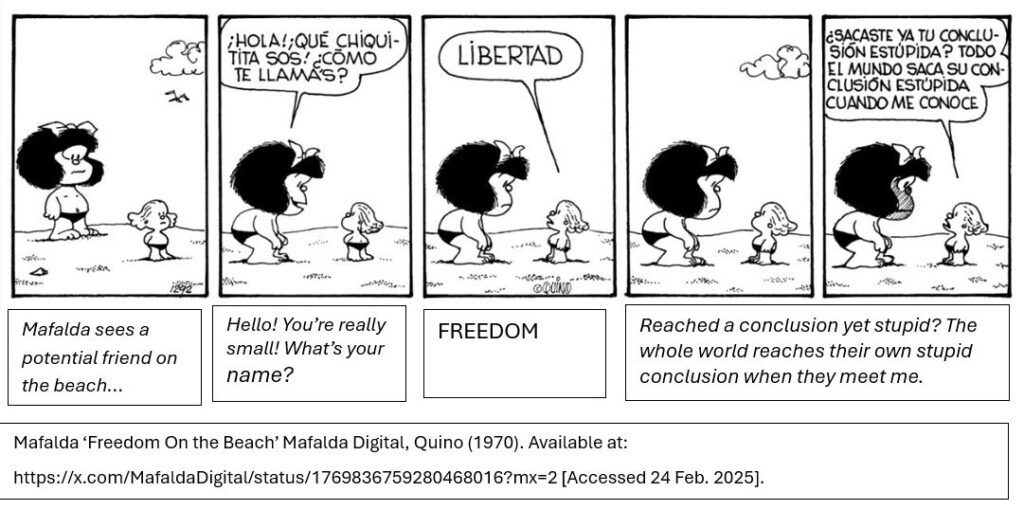
Practitioners face questions relating to freedom each day when teaching and planning curricula. How will students engage with the material? How should students be in the learning environment? Do students have the freedom to choose tasks or are they subject to the practitioners preferred methods? This blog challenges the notion of positive and negative freedom, often associated with Isaiah Berlin, by taking inspiration from anarchist thought. Anarchists have paid particular attention to both education and the idea of freedom. Considering teachers and curriculum planners as individual decision makers within a defined context a pragmatic approach to freedom is more coherent than the dichotomy of positive and negative freedom.
At first glance, Isaiah Berlin’s (1958) idea of positive and negative freedom offers a useful framework. Positive freedom can be thought of as the freedom to. Rules or regulations are put into place to guarantee individuals have access to certain actions. Negative freedom on the other hand is often explained as freedom from. Removing barriers and constraints leaves options available. This distinction between freedom to and freedom from provides little clarity (Swift, 2006, p.53). For, it follows, that if you have positive freedom, you necessarily have negative freedom. Consider, for instance, the example of freedom of speech. Are you free to say certain things or free from saying certain things? Likewise, with freedom of information. Are you free from a company or organisation keeping their records about you secret or do you have the freedom to see the information held?
These examples demonstrate a limitation in the thought of Berlin: having positive freedom necessarily entails having negative freedom. For example, in group work, students are free from intervention by the teacher and have the freedom to make decisions about how they work in the group. In an oral assessment students are free from the pressure of writing an assignment and have the freedom to choose certain elements like language and content. Yet, they are not free from assessment. Cumming and Rose (2021) highlight how universal design for learning can allow learners to engage with the learning process via multiple methods of representation, expression and engagement. Are learners free to engage with the content in various ways or free from having to suffer the teacher’s preferred methods? Alternatively, consider open-ended tasks such as giving students freedom to create either a poster, an essay or a presentation; this would include freedom from direction by the teacher and freedom to create the product however the student wishes. These examples show that freedom is a deeper issue than that of a tension between the external conditions that enable freedom and the internal capabilities that allow individuals to realise and exercise that freedom.
Gerald MacCallum (1967) offers a broader tripartite understanding which can offer a clearer framework for understanding freedom in education. MacCallum’s model includes three components: X the agent, (or subject); Y the constraint or obstacle; and Z, the goal, or end. Applied to the classroom context, students are the agents (X), the constraints (Y) are the learning material or curriculum, and the goal (Z) can be thought of as both the long-term qualification and the short-term objectives of the class. This conception avoids creating a dichotomy of positive and negative freedom. Something Cooper highlights as the ‘two sides of the same coin’ (Cooper et al., 2023). MacCallum’s approach allows us to view learning as a process that is actively worked on, with a clear goal in mind much like the everyday work of an instructor. In contrast, Berlin’s conception of freedom lacks a goal. Instead, the idea of freedom is defended as an intrinsic value something that exists as an end in and of itself. MacCallum’s model does not attempt to define freedom. Rather than freedom as an end in and of itself, freedom becomes a goal that requires consistent work. Freedom remains dynamic and unanswered. A benefit of maintaining that freedom is something to be worked towards avoids the pitfalls of definition and allows for the creation of educational goals.
However, both MacCallum and Berlin ignore feelings such as self-worth and self-respect as explored by Rawls (1982). Teachers have the task of creating the conditions in which all students feel like they have the freedom and are empowered to act. Student A may have the positive freedom to speak their views on a certain topic as they have the confidence to enable them to act. Student B may have a logically stronger idea; however, due to A’s confidence, B feels unable to express the counterargument. Mapping Berlin’s concept of positive freedom, the second student lacks a mastery of themselves. Berlin explains that one does not have positive freedom if one is not a master of oneself. Plato, in book four of The Republic, offers a criticism. The phrase ‘master of oneself’ is a ridiculous absurdity as both phrases refer to the same person: to be master of oneself implies one is also a slave to oneself. This critique highlights the problem that positive freedom is dependent on negative freedom. Carolyn M. Stone (1990) notes “[t]he notion of autonomy, which links up with ideas of self-direction, self-motivation and ‘being a chooser’ became popular during the liberal progressive era of the 1960s and early 1970s. Conceptualisations of autonomy from this period failed to consider the “role of feelings, emotions and desires”. In the example of the student who is the not willing to speak we can see how freedom is dependent on others. Promoting responsible being in the world through responsibility to others. In this case through the simple act of listening and respecting others. Freedom is a shared concept that must be worked on together. Not simply a dichotomy of freedom to and freedom from which focuses on the self. Thus, to account for others outside of the self it might be more useful to think to arrive at freedom with, instead of from and to. The freedom of one rests on the freedom of another. In the words of Bakunin (1871) ‘I am not myself free or human until or unless I recognize the freedom and humanity of all my fellowmen’. Thus, my freedom depends on your freedom.
The existence of a separate notion of positive and negative liberty is unclear. Freedom is not a dichotomy. It cannot be divided into freedom to and freedom from. I have argued that ‘freedom with’ is a more comprehensive understanding of freedom as it considers how we exist in the world through our actions with others rather than just a focus on ourselves. In this way the freedom of one person is interconnected with the freedom of others – my freedom depends on your freedom. Therefore, freedom becomes something to work on, to actively engage with, a goal to pursue rather than an end in and of itself. Thinking about freedom pragmatically allows everyone to consider how they can contribute to the freedom of others, avoiding an individualistic conception of ‘freedom from’ and ‘freedom to’, which often solely focuses on ‘my freedom’.
References
Bakunin, M. (1871) Man, Society and Freedom. In: Dolgoff, S. (1971) Bakunin on Anarchy Translated and Edited by Dolgoff, S. New York: Vintage Random House, pp.234-243 Available at https://files.libcom.org/files/Bakunin%20on%20Anarchy%20(1971).pdf [Accessed 28 Feb. 2025]
Berlin, I. (1958). Two Concepts of Liberty in A. Quinton (Ed.) Political Philosophy, Oxford University Press, Oxford Readings in Philosophy, 1967, pp.141-52.
Carter, I. (2021). Positive and Negative Liberty (Stanford Encyclopaedia of Philosophy). [online] Stanford.edu. Available at: https://plato.stanford.edu/entries/liberty-positive-negative/.
Cooper, A. and Mtawa, N. (2023). Comment on Yunus Ballim’s ‘The place of teaching, learning and student development in a framework of academic freedom: Attending to the negative freedoms of our students’. Journal of Education, (89), pp.1-6. doi: https://doi.org/10.17159/2520-9868/i89a11.
Cumming, T.M. and Rose, M.C. (2021). Exploring universal design for learning as an accessibility tool in higher education: a review of the current literature. The Australian Educational Researcher, 49(5). doi:https://doi.org/10.1007/s13384-021-00471-7.
McWilliam, E. (2009). Teaching for creativity: From sage to guide to meddler. Asia Pacific Journal of Education, 29(3), pp.281-293. doi:10.1080/02188790903092787.
Möller, K. (2009). Two Conceptions of Positive Liberty: Towards an Autonomy-based Theory of Constitutional Rights. Oxford Journal of Legal Studies, 29(4), pp.757-786. doi:https://doi.org/10.1093/ojls/gqp029.
Rawls, J. (1982) ‘Social unity and primary goods’, in A. Sen and B. Williams (eds.) Utilitarianism and Beyond. Cambridge: Cambridge University Press, pp. 159–186.
Plato. (1997). The Republic Translated by John Llewelyn Davies and David James Vaughan, Introduction by Stephen Watt. London: Wordsworth.
Stone, Carolyn M. (1990). Autonomy, emotions and desires: Some problems concerning R. F. Dearden’s account of autonomy. Journal of Philosophy of Education, 24 (2), pp.271-283. https://doi.org/10.1111/j.1467-9752.1990.tb00239.x
Swift, A. (2006). Political Philosophy: a beginners’ guide for students and politicians. Cambridge: Polity.