This year, the PESGB (Philosophy of Education Society of Great Britain) commenced celebrations for its 60th anniversary with its annual conference held from 27 – 30 March 2025. 184 distinguished academics and teachers from diverse fields and countries descended upon New College, Oxford. Fascinating academic events included four keynote speeches, an invited anniversary panel, 65 paper presentations (including works-in-progress), 27 posters, 10 symposia and three workshops. Beyond the academic programme, the 2025 PESGB conference also offered entertainment activities to enhance the jovial atmosphere. These included a concert in the New College Chapel featuring the incredible pianist Aïda Lahlou; a philosophical film screening of Young Plato documentary, opened by its star, Belfastian head teacher Kevin McArevey; a PESGB Pub Quiz, a singalong and party on the Saturday night after a formal college dinner and even a flying circus!
On the 27th March, the PESGB conference began with a pre-conference workshop for graduate students, led by Graeme Tiffany. Graeme encouraged students to ask each other a philosophical question as an icebreaker. Following the discussion, Graeme took students on a guided walk through Oxford, illustrating how the surrounding environment and personal reflection intersect in philosophy. He emphasised the important educational value of activities beyond the school walls. The workshop was followed by the official opening of the conference, which commenced with Yuriko Saito’s keynote, entitled The Role of Aesthetic Education in Everyday Life. Yuriko advocated for observing everyday aesthetics, highlighting how seemingly ordinary objects and actions can hold aesthetic significance. For example, a clay cup, even if cracked, retains aesthetic value, while routine tasks like cleaning can reveal unexpected beauty when viewed from a different perspective. She encouraged participants to reflect on aesthetic value in their daily lives.
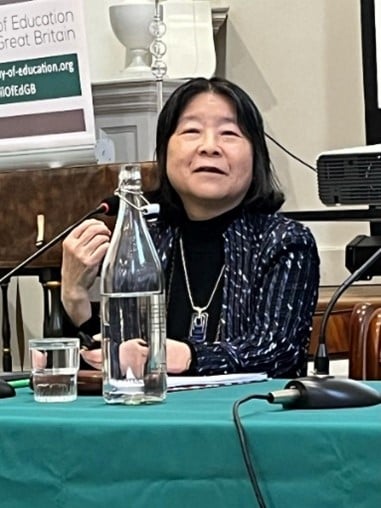
[Yuriko Saito]
On the 28th March, the second day of the conference, Amy Shuffelton delivered her keynote, entitled After the Revolution: Education and the Power of Disappointment. Amy argued that disappointment creates a space for education in ways that hope alone cannot. As a political emotion, disappointment forces us to confront both our history and our aspirations, recognising the complexity, contingency, and collective nature of human affairs. Drawing on Frankenstein and presenting Mary Shelley as a philosopher of education, she explored how the novel teaches us to face disappointment without despair, to remain present while reflecting on the past, and to envision an open future. Verney exemplifies this by adopting a sheepdog, immersing himself in great literature, and embarking on a hopeful journey. In the wake of revolution, disappointment becomes a crucial lens – steering us away from false hope and self-affirming despair – through which we can assess history and imagine political futures. Ultimately, Amy concluded, Mary Shelley offers a simple but enduring lesson: if all else fails, find a good book and adopt a dog.
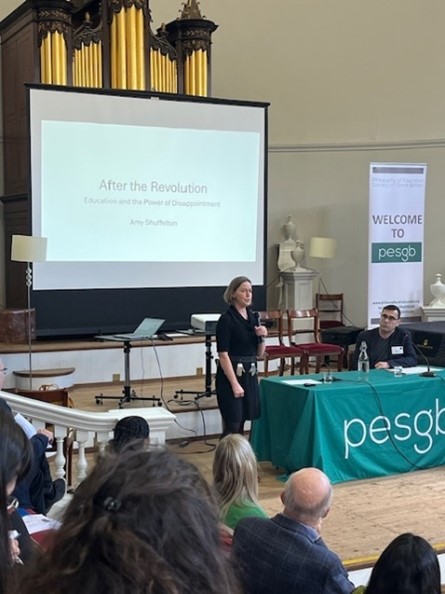
[Amy Shuffelton]
Amy’s keynote was followed by an invited anniversary panel, chaired by Ka Ya Lee and featuring Paul Standish, Doret de Ruyter, Rowena Azada-Palacios and Drew Chambers. This panel drew on the experience and wisdom of philosophers of education across generations and countries. They considered the shifts in topics, themes and research in philosophy of education over the past 60 years and entertained the question about what had been missing and what should be attended to more in the future.
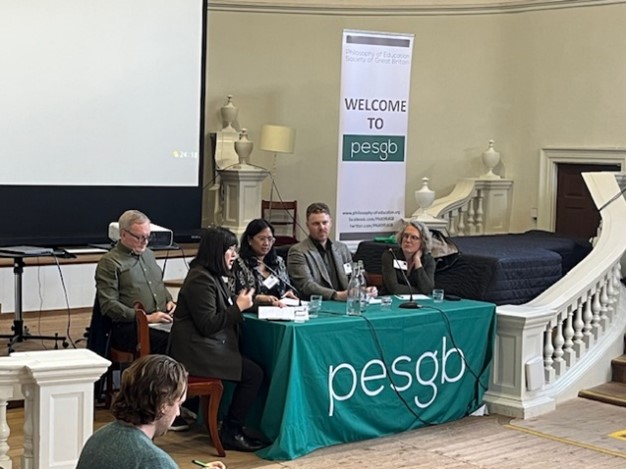
[Ka Ya Lee, Paul Standish, Rowena Azada-Palacios, Drew Chambers and Doret de Ruyter]
On the 29th March, the third day of the PESGB conference began with the traditional 7.5 km run at 7:00 am (thankfully participation was optional!). Later that day, Johannes Drerup delivered his keynote talk, entitled Teaching Progress? On the Role of History in Democratic Education. Johannes suggests that history education should provide students with a way to examine sociopolitical struggles and conflicts, the historical formation of these conflicts, and the potential for change in the future. To this end, Johannes argues that we should distinguish between teaching about progression and teaching for progression. He then calls for us to go beyond teaching progression to recognise the wrongs and injustices of the past in education, which he refers to as regression. Moreover, Johannes argues that by teaching the history of both progression and regression, we can explicate and justify normative criteria, which provides crucial knowledge in democratic education. This teaching process contributes to the development of our democracy both in the present and in the future, and is, therefore, itself an expression of progression.
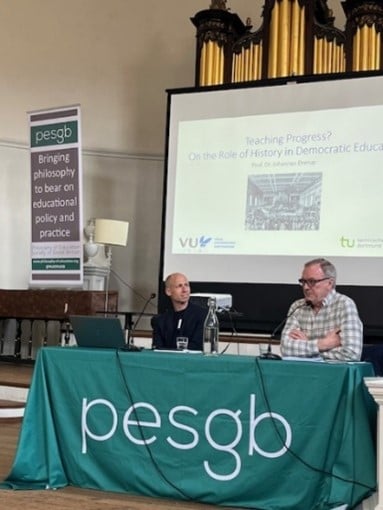
[Johannes Drerup]
The final day of the PESGB conference concluded with James [Jim] Conroy’s keynote, entitled The Emergence of the Appetites and Education Across Sixty Years. In this talk, Jim distinguishes between two kinds of appetites, caritas and cupidity. Caritas is the foundational love of the world, while cupidity is the desire for possession. Jim reminds us that we should be alert to the danger of education slipping from caritas to cupidity. That is to say, as teachers we ought to be alert to the potential danger of being egoistical in our attempt to possess students’ ideas and affections instead of directing them towards knowledge and wisdom.
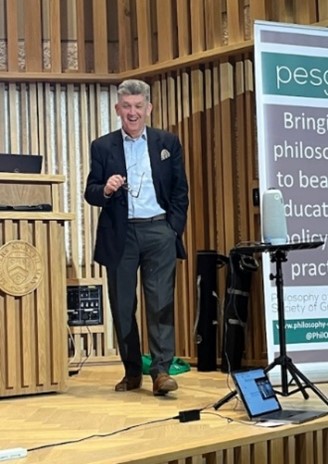
[James Conroy]
The four-day conference brought together researchers, students, and educational practitioners from around the world. Attendees enjoyed fruitful intellectual conversations, singalongs and great food and drink as they celebrated PESGB’s 60th birthday together. There are more anniversary events planned throughout the remainder of this year so check those out on the PESGB website. In the meantime, we are already looking forward to next year’s conference and meeting again at New College, Oxford between 27-29 March 2026.
Some final personal reflections:
As a PhD student and student helper at the PESGB Conference 2025, I enjoyed both attending and supporting the event. My presentation on character education and well-being received valuable feedback from international academics and teachers, helping me reflect on different contexts and the link between theory and practice. These exchanges enriched my PhD research and offered me insight into current topics in educational philosophy. I especially valued conversations with teachers whose practical experiences deepened my theoretical understanding. Helping run sessions and events also gave me a new appreciation for the behind-the-scenes work that makes a conference succeed. Overall, I’m grateful for the opportunity to contribute and to learn from such inspiring educators at the PESGB conference. – Catherine
As a PhD student and a very junior researcher, I felt that the atmosphere at the conference was friendly and inclusive. From professors who have been attending conferences for decades, to teachers in schools and undergraduates – all were actively engaged in the conversation, expressing ideas and offering constructive feedback. I gained a lot of feedback and heard about the experiences of other attendees from different backgrounds, which gave me a clearer direction and motivation for my future research. People were intellectual and critical in day sessions and they became fun and relaxed in evening entertainment activities. I’m proud I’m part of the community. At PESGB, we are colleagues and friends. – Ping
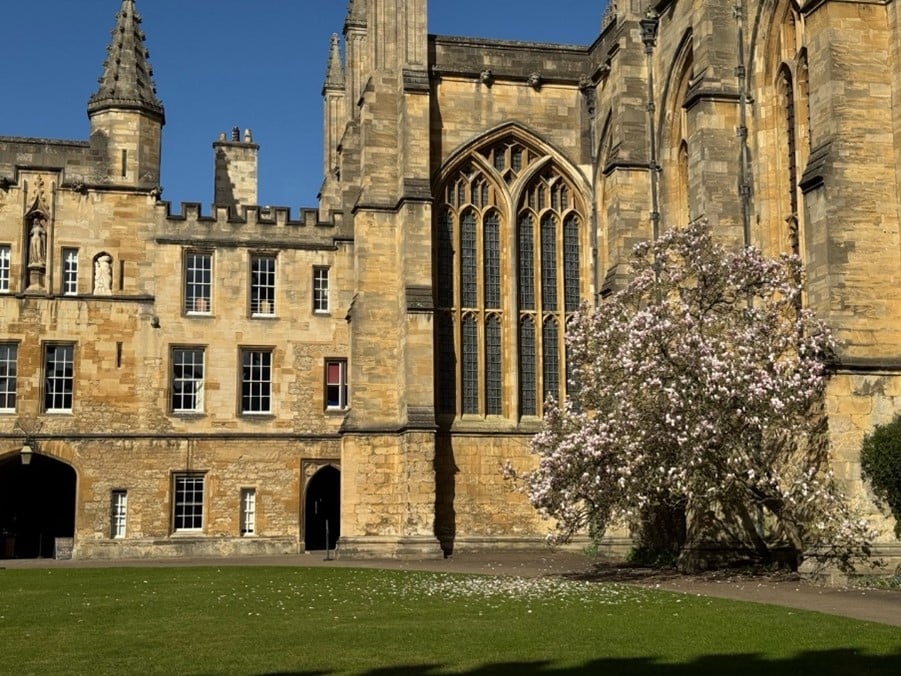
[New College, University of Oxford]