

This post is available as a PDF here.
***
Healthy body, healthy mind isn’t a modern but an ancient axiom. In Plato, for canonical example, bodily discipline is a crucial strand of moral education; and though Plato denigrates the physical – we should aim to move beyond the physical world of appearances towards the metaphysical realm of ultimate truth – it’s by means of physical training and discipline that we lay the groundwork for the fine tuning of the soul (as we must make our way through Plato’s cave to the light of truth, so too must we approach spiritual improvement by way of the flesh). In Plato, the relationship between individual and civic health is both analogical (a healthy society is structured like a healthy person) and fractal (a healthy society is built of healthy individuals). In Jowett’s words, ‘the State is the visible embodiment of justice […]. The one is the soul and the other is the body, and the Greek ideal of the State, as of the individual, is a fair mind in a fair body.’
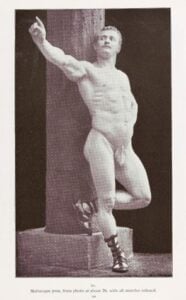
As well as running through such traditions as Yoga, Alexander Technique, and Pilates (originally ‘Contrology’), the logic of healthy mind, healthy body informs the health, fitness, and strength industries that emerged at the fin de siècle and developed over the course of the twentieth century, though with modernity’s humanistic turn, physical improvement becomes the pathway less to transcendent truth than to personal spiritual improvement (be the best you that you can be). Bodily discipline is now connected to self-authorship or -cultivation – to bildung – and the body and its sculpting are imagined, on the one hand, in machinic or functional terms (Platonism with a twist, as we’ll see), and, on the other, aesthetic terms. Both modes remain alive and well today (scroll the various health and fitness posts and ads on social media; scan a selection of front-page splashes from any health-and-fitness magazine); and the importance of bodily training need not be articulated in terms of only one or the other. Eugen Sandow is a point of origin for both.1
Source: Wellcome Collection (online)
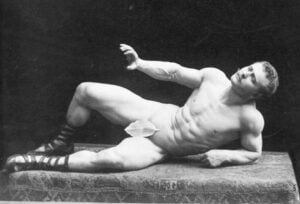
Born Wilhelm Friedrich Muller in 1867, and lauded as the world’s most perfect man by frequent comparison with Greco-Roman statuary’s idealized male forms, Sandow expertly sold himself and his physique. Sandow training kit was popular in the early twentieth century (Hemingway’s narrator in The Sun Also Rises mentions a Sandow machine, for example); customers were promised remarkable transformations if they followed the scientific Sandow method.
Source: Wikipedia
Sandow also fashioned himself as an educator and (would be) social reformer. He established a small chain of Sandow schools (and many other schools professed to teach his methods). He published numerous instructional books, and is credited on the cover of his 1919 volume Life is Movement: The Physical Reconstruction and Regeneration of the People (A Diseaseless World) as ‘Professor of Natural Therapeutics’ and ‘Instructor in Physical Culture to H.M. the King.’
Life is Movement is a follow-up to 1907’s The Construction and Reconstruction of the Human Body. Both titles exemplify the machinic attitude: here, the body can be rebuilt, repaired, refined. The subtitle of the later work, written in the wake of the First World War amid concerns over national degeneration and reduced potency, makes clear Sandow’s collective ambitions. Here, then, is Platonism twisted modern: as goes the perfection of the individual, so goes the perfection of the state. But though the Platonic metaphysics remains – ‘health and strength cannot long live and flourish in the same human body as immorality and vice’ (88) – to it has been added a modern mechanics (this is, after all, the era of Taylor and of Ford). As well as with a Platonic ‘Higher Ethics’ (or moral truth), Sandow is also concerned with ‘the real and true gospel of efficiency’ (88). Sir Arthur Conan Doyle approved heartily of Sandow’s methods and ethos, and he looked forward to a time when the state would take control of citizens’ bodies just as it had their minds with the passing of the 1844 Education Act.
As Rancière says, politics and aesthetics imply one another (taste is ideological; ideologies require expressive forms and styles), and we can, I’d like tentatively to suggest, map Sandow’s ideology to his sculpted yet modest physique, which surprised because, beneath the gentleman’s attire he wore on stage (before performing feats of strength) and off, it wasn’t obviously powerful or massive. The Sandow-type body is well-integrated into and trained to contribute to a well-ordered society: ‘Morality, efficiency and even religion are too closely inter-related with physical fitness and bodily health, for the latter to be made secondary to any other educational development,’ Sandow proclaims in Life is Movement (98). The ideal(ized) white male body as metaphor for the ideal(ized) civic body: Sandow is a fitting poster-boy for such high-generality thinking. More locally: classical beauty by modern technoscientific methods – the logic of the Sandow body, it’s tempting to say, is very much that of much current state education policy (in England, certainly, if not elsewhere).
The Sandow body. It impresses, it contributes, but it does not rock the sociopolitical boat. Rather, it steadies its way. The same cannot be said of Arnold Schwarzenegger, the exemplar, in my next post, of the aestheticist mode.
Notes
1Details of Sandow’s life have been drawn from Crompton (2011) and Kasson (2001).
References
Crompton, C. (2011) ‘Eugen Sandow (1867-1925).’ Victorian Review 37(1), pp. 37-41.
Doyle, A.C. (1907) ‘Foreword,’ The Construction and Reconstruction of the Human Body.
Jowett, B. (n.d.) ‘Introduction and Analysis,’ Plato, The Republic. Available online here.
Kasson, J.F. (2001) Houdini, Tarzan, and the Perfect Man: The White Male Body and the Challenge of Modernity. New York: Hill and Wang.
Rancière, J. (2004) The Politics of Aesthetics. Ed. and trans. Gabriel Rockhill. London: Bloomsbury.
Sandow, E. (1907) The Construction and Reconstruction of the Human Body: A Manual of Therapeutic Exercise. London: John Bale, Sons and Danielsson, Ltd.
Sandow, E. (1919) Life is Movement: The Physical Reconstruction and Regeneration of the People (A Diseaseless World). The Family Encyclopaedia of Health. Available online here.
*Oli Belas is Senior Lecturer at the University of Bedfordshire, where he teaches Education and English. He is co-chair of the PESGB’s Committee on Race and Ethnicity.

_-_Eugen_Sandow_(1867-1925)-_1894-cropped.jpg)