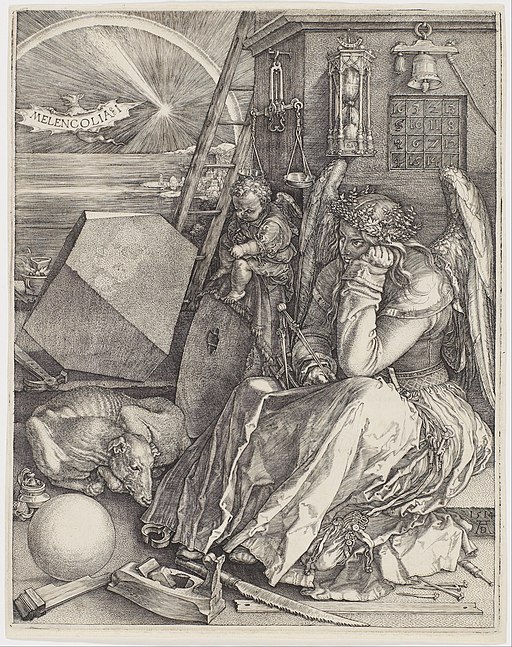
(Melencolia I, Albrecht Dürer, Public domain, via Wikimedia Commons)
What is to be done except learn all we can about everything we can? Education is a force of civilisation. Through it we have become who we are. Our curiosity and our adaptability both stem from beginnings in absolute universality. No God-given wings dragged us towards the skies. No evolutionary gills led us deep into the oceans. Yet we went there, and further, precisely because we had no natural specialisation guiding us. It is an extraordinary Humanist vantage point where ‘you may, as the free and extraordinary shaper of yourself, fashion yourself in whatever form you prefer’ (della Mirandola, 2012, p. 22). This latent polymathy found its utmost embodiment in the ‘Renaissance Man’ Alas, he has been pronounced dead.
The restraints being put on education today make realising the polymathic potential increasingly difficult. And thus, I argue, all the more necessary. We should be suspicious of any force that seeks to restrain our potential. Today, there is an inner restraint in the drive of specialisation, an outer one in the professionalisation of disciplines, and lastly, a political restraint in the criminalisation of fields of education. Taken individually, they hamper the human capacity for learning. Pooled together, they reduce the free-thinking human to the narrow-minded tool of someone else. What we are witnessing in universities today are classrooms as battlegrounds. Specialisation and professionalisation have put pressure on our latent polymath, criminalisation has been the catalyst. We are engaged in a struggle of, and for, education where what is at risk is our very potential for learning. This war we cannot afford to lose. It is the first point of contact between totalitarian pressure and human resistance. These interactions are the touch points of history’s ‘race between education and catastrophe’ (Wells, 1951, p. 1192). And when it comes to true unrestrained learning, the polymath is the vanguard.
Polymathy is not only the realisation of the individual’s curiosity for learning. It is an all-encompassing contemplation of our world. In Bertrand Russell’s words, ‘contemplation enlarges not only the objects of our thoughts, but also the objects of our actions and our affections: it makes us citizens of the universe, not only of one walled city at war with all the rest’ (Russell, 2019, p. 110). Division creates walls. Walls breed hatred. Within education, the key division is that between art and science. No longer is it possible to straddle both. This schism has given rise to disciplines no longer speaking with one another. Education thus divided and reduced does not stand a chance against totalitarian forces thriving in division and reduction. The separation of art and science is the primordial sin that separates the learner from the totality of learning. From that point it is a slippery slope to dislodging the human from the totality of humanity.
It is therefore not just an educational standpoint to expose this dichotomy as a false one. It is a political quest to prove that the polymath can transcend it for our common good. Yes, art and science are different. One rests on creativity and the other on discovery (Kant, 1914, p. 190). However, they are not mutually exclusive. Although that is the dangerous silo-based thinking we are moving towards. Polymathy’s strength is the equilibrium between art and science. In fact, it is ‘the balance of apparent contradictions that has been the whole buoyancy of the healthy man’ (Chesterton, 1909, p. 47). This inner multitude is what will outwards foster connections between disciplines and people. Stefan Zweig writes of the supra-national community of artists in The World of Yesterday (1942). In a time of increasing national division, art held Europe together. This world perished. The war machine killed the artist’s soul. After the Second World War, the arts no longer carry the same torch of unity and leadership. No, ‘science is now in a position to become the leader of the humanities’ (Waddington, 1948, p. 61).
The torch has passed from the hand of artistic creativity to that of scientific discovery. That is a pressing problem. Science does not represent the same kind of unity. It is constantly in danger of becoming victim to national agendas precisely because it cannot create its own. We rally behind science, but its promise of impersonality renders it useless in fostering the personal relationships we need. It is the polymath, with both hands, who must pick up the mantle of unity, combine the art of The World of Yesterday with the science of today, and set them both to work for a united world of tomorrow. In history’s race between ‘education and catastrophe’ we must boldly pursue the former. In education, no one is bolder than the polymath. No one is more curious, no one more understanding, and no one more apt to discover what we all have in common and create the space to share it.
References
Chesterton, G. K. (1909). Orthodoxy. John Lane.
della Mirandola, P. (2012). Oration on the Dignity of Man. Cambridge University Press.
Kant, I. (1914). Kant’s Critique of Judgement. Macmillan and Co., Limited.
Russell, B. (2019). The problems of philosophy. IAP.
Waddington, C. H. (1948). The Scientific Attitude. Penguin Books.
Wells, H. G. (1951). The outline of history. Cassell and Company, Ltd.