
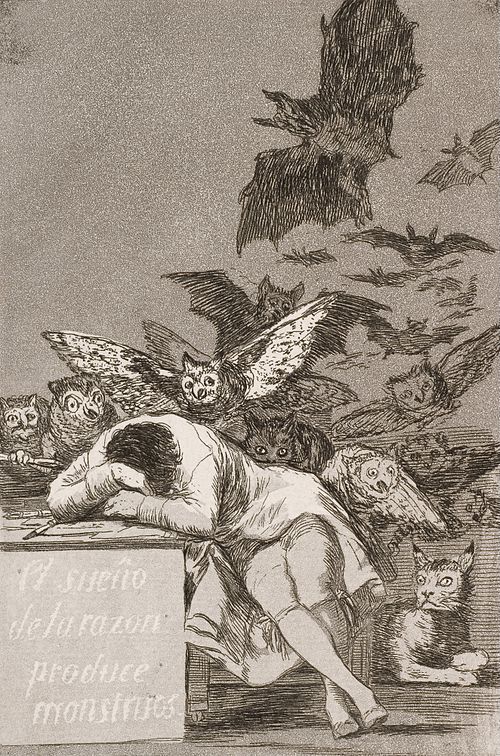
Francisco Goya, El sueño de la razón produce monstruos (1799).
With the support of a small grant from the PESGB, I recently attended the Association for Moral Education’s annual conference, hosted by Tampere University in Finland. I presented a poster highlighting an ethical problem with moral education studies. In short, moral development involves becoming increasingly autonomous – that is, able to act on values that you genuinely endorse (e.g., Aristotle, 2004; Kant, 2012; Kohlberg, 1981). Accordingly, moral education seeks to foster autonomy in young people (e.g., Jubilee Centre, 2022). But there’s a problem: according to ethical research guidelines (e.g., BPS, 2021), moral education studies usually recruit voluntary participants. Yet volunteers are, by definition, already autonomous – otherwise, they wouldn’t have volunteered! As a result, studies tend to include only those already disposed to virtue. Meanwhile, less autonomous individuals – those who arguably need more support – are systematically excluded. This sampling bias risks creating an ever-widening ‘character gap’. One way to correct this bias is to use extrinsic motivators (e.g., rewards) to widen participation. This could bring in students lower on the autonomy spectrum, making samples more inclusive and representative. This approach, although not without risks (e.g., ‘motivational spillovers’ [Gubler et al., 2016]), could help close the character gap. That was the main thrust of my poster, and I received some very useful feedback. In particular, several scholars encouraged me to clarify what I understood by the term ‘autonomous’. I had little time to devote any serious thought to this during the conference. Now, here, I have more time…
My concern with autonomy is ultimately an educational concern, originating in R. S. Peter’s (1981) famous ‘paradox of moral education’; namely: how can ‘the Palace of Reason’ be entered uncritically ‘through the courtyard of Habit and Tradition’ (p. 52). In other words, how can we encourage young people to think for themselves? Because if our encouragement succeeds, then to what extent are they really doing it themselves? The paradox is sometimes reformulated as follows: how can one become autonomous (self-governing) through heteronomous (other-governed) training (e.g., Kristjánsson & Fowers, 2024)? In other words, how can we encourage young people to act on their own reasons? Because, again, if our encouragement succeeds, then to what extent are their reasons really their own? At first sight, the reformulation seems to point to a different paradox, because presumably one might act on reasons that are their own without being consciously aware of those reasons, let alone subjecting them to constant critical scrutiny. I believe the assumption linking the two formulations is that reasons become one’s own through a conscious process of critical reflection – ‘thinking for oneself’. Once the process is complete, however, the reason can be stored away ‘as one’s own’ below the level of conscious scrutiny – at least until one has reason to dredge it back into the light. Combining both formulations, then: how can we encourage young people to think for themselves so that they might thereby come to act on reasons that are their own? This is what I have in mind when thinking about ‘autonomy’ (I think).
Now, returning to my poster: is a young person who volunteers to participate in a moral education intervention necessarily autonomous – that is, acting on their own reasons? Not at all! They might be trying (uncritically) to impress someone; or perhaps participating in the intervention would give them a convenient excuse not to attend some less appealing alternative. Conversely, is a non-volunteer necessarily not acting on their own reasons? Certainly not. They might have prior commitments, made as a result of thinking critically for themselves. In short, whether a young person volunteers for an intervention reveals nothing conclusive about whether they have acted on their own reasons – volunteers are not autonomous by definition.
What does this mean for my argument? Should I delete all evidence of my poster? That would be too hasty, I think, for the argument does not depend on necessities, only likelihoods. I think we can safely say that those who actively volunteer to participate in an intervention, especially prior to any mention of incentives, are more likely to be autonomous (acting on their own reasons) than those who do not volunteer. From my own experience as a teacher, at least you can guarantee that those who volunteer are consciously present in the room, which couldn’t be said with the same confidence for non-volunteers. Thus, the problematic sampling bias is still likely to arise: autonomous individuals are likely to be over-represented among study samples, which could lead to a ‘character-gap’.
I have almost run out of words and have said nothing about whether the paradox of moral reason can be resolved! Suffice it to say, I think recent treatments have been surface-level (e.g., Vigani, 2024). For behind the paradox lurks a much deeper problem, one which has occupied philosophers for millennia. Alas, that will have to wait until another day.
References
Aristotle. (2004). The Nicomachean ethics. Penguin.
British Psychological Society [BPS]. (2021). BPS code of human research ethics. The British Psychological Society. https://explore.bps.org.uk/content/report-guideline/bpsrep.2021.inf180
Gubler, T., Larkin, I., & Pierce, L. (2016). Motivational spillovers from awards: Crowding out in a multitasking environment. Organization Science, 27(2), 286–303.
Jubilee Centre for Character and Virtues. (2022). Framework for character education in schools. University of Birmingham. https://www.jubileecentre.ac.uk/wp-content/uploads/2023/08/Framework-for-Character-Education-3.pdf
Kant, I. (2012). Groundwork of the metaphysics of morals (M. J. Gregor & J. Timmermann, Trans.; Second edition). Cambridge University Press. https://doi.org/10.1017/CBO9780511919978
Kohlberg, L. (1981). The philosophy of moral development. Harper & Row.
Kristjánsson, K., & Fowers, B. J. (2024). Phronesis: Retrieving practical wisdom in psychology, philosophy, and education. Oxford University Press. https://doi.org/10.1093/oso/9780192871473.001.0001
Peters, R. S. (1981). Reason and habit: The paradox of moral education. In Moral development and moral education. Routledge.
Vigani, D. (2024). Habituation into virtue and the alleged paradox of moral education. Social Theory and Practice, 50(1), 157–178. https://doi.org/10.5840/soctheorpract20231129210
