Throughout the twenty five years I worked in UK higher education I was persistently exercised by the concept of quality. Something never seemed quite right. I believed in it; I knew that, but I seemed to inhabit an environment where the word was constantly being bounded about by its institutional guardians, the majority of whom I never really trusted to do right by it. How many staff development events did I attend – across the HE sector – where that word was all over the PowerPoint slides, and where the message seemed to be: we need to do this in order to enhance it. And where ‘this’ invariably amounted to following some new rules, and ‘it’ was never analysed. In my head I was always thinking: will one of you please actually define the concept of which you speak; and is excellence now just a badge for being good boys and girls? My recollection is that both words – quality and excellence – were used pretty much interchangeably, inferring that they meant the same thing.
I am a teacher educator, with a background in sociology and philosophy, and, because of that, Howard Becker often pops into my head; his idea that a ‘good’ student is simply one who does what a teacher asks. I always felt comforted by that: maybe words like ‘good’ don’t really mean much; don’t have any real depth. However, maybe that’s where the real problem is: because words like ‘quality’, ‘excellence’ and ‘good’ are somewhat amorphous and slippery in nature, they might be easy to hijack. Does that matter? Probably not, if we can all see what’s behind the curtain. Unfortunately, if the wizards of quality have power and can produce high- stakes environments, it’s not so easy to raise your hand in a meeting and point out that they trade in fakery, or that ‘the king is in the altogether’. And, at heart, we do actually want to believe in those words; don’t we? Who doesn’t want their child to go to a ‘good’ school. It’s almost intuitively obvious.
The main theme of my research work has been in the meaning and concept of higher education, but I found myself struggling to compose the outline of an article specifically on quality in higher education. Looking for inspiration, I started collecting stories from colleagues about their experiences with quality regimes in their institutions, and in idle moments I started threading them together. Some of the stories spoke of anger, but some struck me as being very funny. Which got me thinking: maybe I could analyse the concept of quality in the form of a campus novel. I begin by inventing two lead characters, Lotte and Jack, one a philosopher, the other a sociologist, both with a keen interest in the art and craft of teaching. To enhance the human interest I also made them unconventional lovers. The arc of the story came to me quite quickly: it would chart their romantic attachment to each other over a fifteen year period, mirrored by their romantic attachment to the concept of quality.
The novel form gave me licence to exaggerate Jack and Lotte’s sense of paranoia and anger, about their own lives and how this was mirrored in their professional lives; that they perceived their institution as being against them in some way. Their fictitious colleagues were amalgamations of people and sentiments I had come across throughout UK higher education, and the scenarios in the book were loosely based on the accounts of quality regimes I had started to collect. As the story progressed and the characters started to take on a life on their own, the questions they kept asking themselves started to have a familiar ring: when did we, as teachers, lose control of our own professionalism, and why did we let this happen? Their paranoia and anger dissipate as their deliberations begin to weave together, not just the nature of the problem, but also what needs to be done about it. At this point, a sense of calmness settles around them – along with the colleagues they persuade to join them – as they start to shape their mission.
Throughout the novel, Lotte and Jack are haunted by the post-modern turn, and whether educational realities are simply a Nietzschean army of metaphors. At first there is some comfort here, particularly for Jack, because it confirms to him that quality is a mere social construct, but, increasingly, both of them end up grappling with the idea that quality is real, but needs to be captured by considering what it is that humans do when they are fully invested in something. Lotte can see how that might be connected with the concept of `student engagement’, and Jack begins to see how the `commodification’ of education – that education has become a series of objects, being bought and sold – militates against this. The denouement takes them beyond the university walls, to consider how the true meaning of higher education and quality are intimately entwined.
Who stole quality? Maybe it was all of us, by allowing ourselves to roll over and have it objectified, quantified, and measured, all the while knowing that its true reality was always of another order.
Endnote:
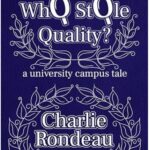
Who Stole Quality? A university campus tale by Charlie Rondeau is available from all the usual book sellers, including Amazon.